From German technology to the ambition of mastering elevator control systems
0
Saturday, 5/9/2026 | 16:01
TCTM - Cooperating with INTEC GmbH (Germany) opens a path for the Institute of Applied Elevator Engineering to receive German elevator control technology. The goal is not only to bring a new product to market, but also to build capacity for research, integration, and gradual production and localization in Vietnam.
Inside the VILEA-INT control cabinet lies a miniature map of the global technology chain: the central control system from INTEC Group (Germany), magnetic tape positioning devices from Germany's ELGO Group, European Finder relays, and Japan's Yaskawa variable frequency drives… All originate from Europe and the world's leading technology nations.
But behind this configuration lies a bigger question: To what extent can Vietnamese engineers master the system?
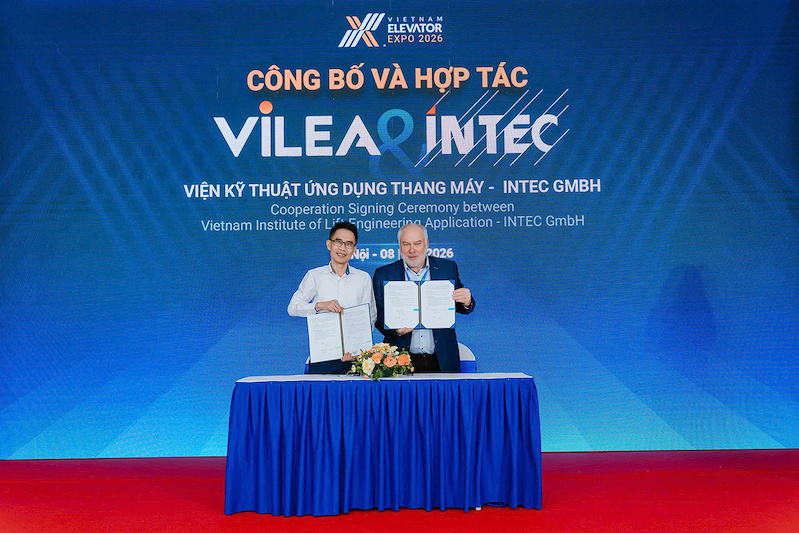
The Institute of Applied Elevator Engineering (VILEA) is seeking an answer through cooperation with INTEC GmbH (Germany), announced in April 2026. The focus is on adopting control solutions using the CANopen-Lift communication system, training personnel, and gradually localizing the technology.
This could be a step toward closing one of the biggest gaps in the domestic elevator industry: The capability to master control technology.
INTEC GmbH signs cooperation agreement with VILEA on transferring elevator control technology meeting European Standards
The Gap Behind the Localization Rate
In 2022, Dr. Nguyen Duc Hanh, Director of the Institute of Applied Elevator Engineering, stated that domestic enterprises could only manufacture about 20-25% of components and equipment, mainly focused on the mechanical segment; the electrical-electronic part was almost entirely imported.
This dependence often becomes evident when elevators require repair or modernization: a circuit board ceases production, diagnostic software has restricted access rights, or components are only compatible with a single supplier. Any of these situations can leave an elevator out of service for days, and repair bills can multiply several times over.
Digitalization further complicates this dependence. As elevators become increasingly connected to building management systems and remote monitoring platforms, the controller also becomes a digital access point—a place where cybersecurity risks can infiltrate if the internal configuration is not fully understood and controlled.
Mastering technology, therefore, does not mean having to manufacture every chip. The core capability lies in understanding system architecture, controlling configuration, diagnosing faults, assessing vulnerabilities, testing changes, and maintaining software throughout the equipment's lifecycle.
This is also the distinguishing point in the cooperation between VILEA and INTEC.
A German control system appearing in Vietnam is nothing new; similar products have been imported through distributors for many years.
What VILEA is pursuing is the knowledge that accompanies the equipment: technical documentation, configuration tools, testing procedures, training, and system development capabilities.
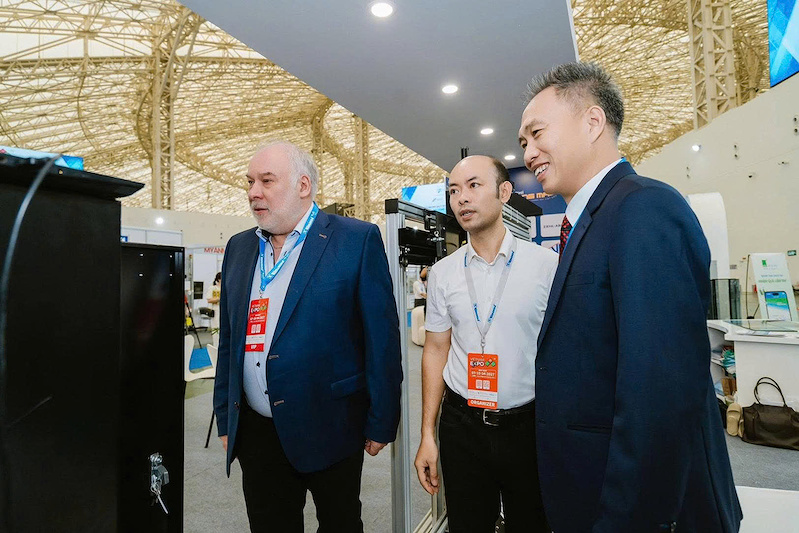
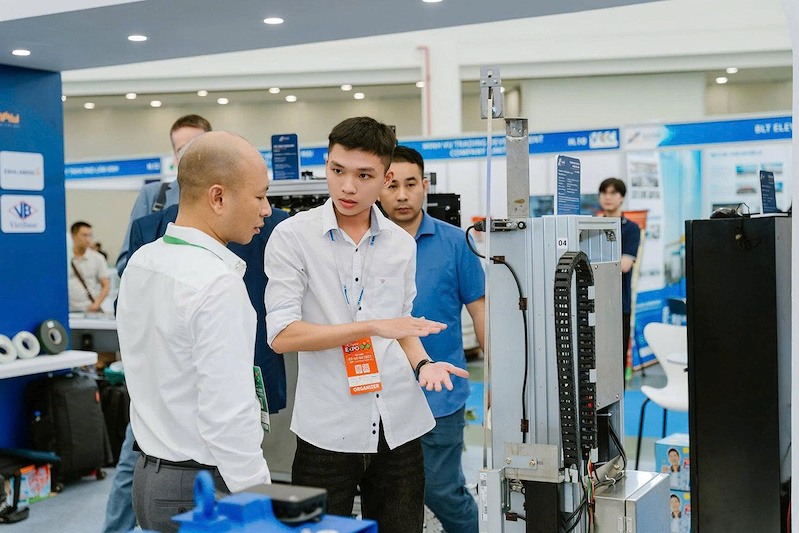
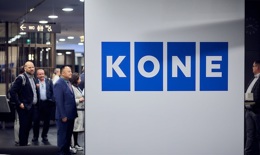
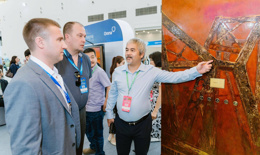
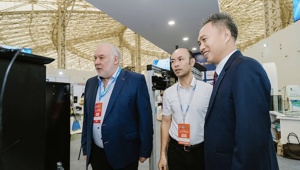
Mr. Peter Zdun, CEO of INTEC GmbH (far left), discusses with Mr. Nguyen Hai Duc, Chairman of the Vietnam Elevator Association (far right), at the exhibition area for the VILEA-INT elevator control solution developed by the Institute of Applied Elevator Engineering.
A Common Communication Language for Equipment
An elevator system consists of multiple devices such as controllers, drives, doors, hall call stations, and sensors. To operate synchronously, these devices must exchange data according to the same rules. If each manufacturer uses a proprietary protocol, replacing a single component can become complicated, potentially forcing owners to remain dependent on the original supplier.
CANopen-Lift is what VILEA has chosen to address this challenge.
If CAN bus is the data transmission highway, CANopen can be seen as the traffic rules, governing how devices identify themselves, exchange information, manage states, and report errors.
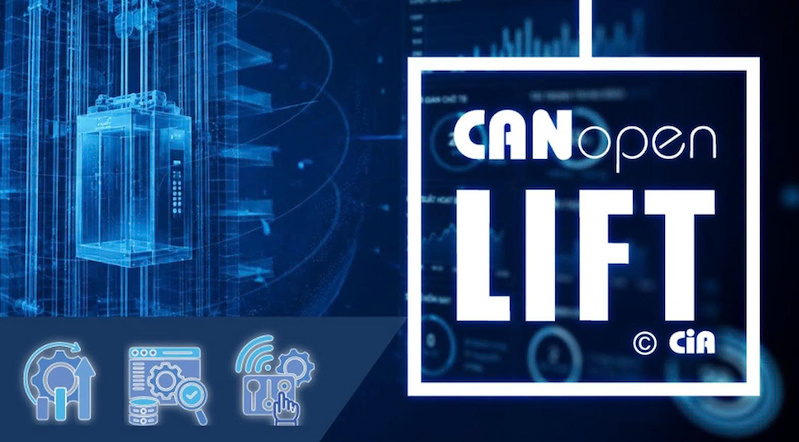
In the elevator industry, the application profile CiA 417, or CANopen Lift, was developed by the CAN in Automation organization to establish a common interface for equipment groups within elevator systems. Notably, INTEC is one of the founding members of CANopen Lift.
This is also the platform adopted and integrated into products by European manufacturers such as ZIEHL-ABEGG, KEB, Bucher Hydraulics, and ELGO.
In Europe, CANopen is currently becoming a communication standard that many manufacturers are expanding and applying; it is forecast to become a trend to combat monopoly, promote interoperability, uphold the right to repair, and reduce dependence on closed technology ecosystems.
Through CANopen Lift, a system can integrate compatible devices from multiple suppliers. Technicians can also work on relatively unified data structures and diagnostic methods, rather than having to learn each supplier's proprietary ecosystem from scratch.
The VILEA-INT control cabinet is how VILEA and INTEC bring that platform into a concrete system. According to information announced by the two parties, the VILEA-INT system features flexible input/output configurations, supports up to 64 floors, and group control of up to 8 elevators.
When devices all comply with a single communication profile, integrating products from multiple suppliers can become simpler. Technicians also have a relatively unified data structure and diagnostic methodology for learning and training, instead of having to familiarize themselves with each supplier's proprietary communication system.
For building owners, a control system using CANopen broadens equipment choices for repairs, upgrades, or component replacement, thereby helping control costs and reducing dependence on any single supplier.
This is the point VILEA hopes to leverage during the technology transfer: establishing CANopen as a common platform for Vietnamese engineers to access technology, practice configuration, develop applications, and gradually engage more deeply in monitoring and designing control systems.
Optimized for Modernizing Older Elevator Systems
After years of focusing on new installations, the Vietnamese market is gradually seeing demand for retrofitting long-operating elevators. Many systems still have useful life remaining but face difficulties due to outdated controllers, discontinued components, or dependence on the original supplier.
Owners are then forced to choose between costly continued repairs and replacing a significant amount of equipment.
VILEA aims to use the CANopen Lift platform acquired through cooperation with INTEC to develop modernization solutions based on an open architecture.
The VILEA-INT control system can integrate with various types of motors, drives, doors, and positioning devices, thereby supporting partial replacement or comprehensive upgrades. Components that remain suitable can continue to be used after being assessed for safety and compatibility.
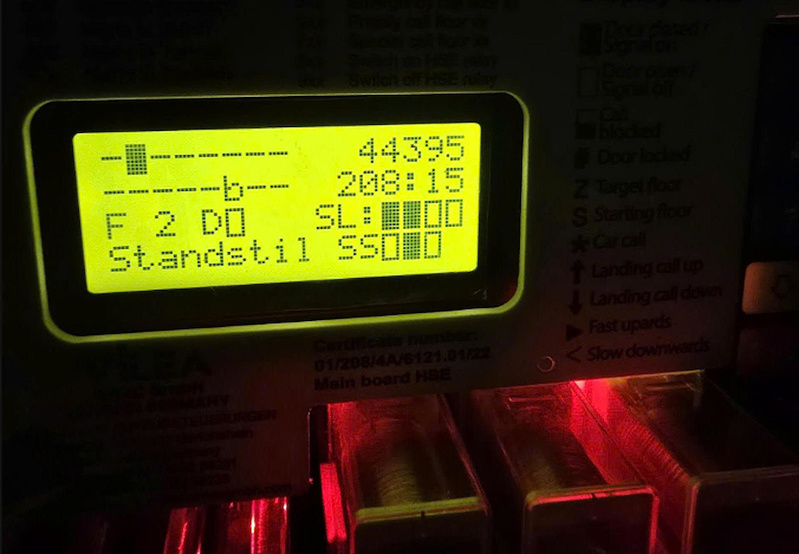
According to VILEA statistics, over the 23 days from April 6 to April 29, 2026, the elevator system at Huu Nghi Hospital (Hanoi), after being renovated and modernized with a new control system, recorded nearly 45,000 trips, equivalent to 2,000 trips per day.
According to VILEA, the VILEA-INT control solution has been applied to modernize several elevator systems and has demonstrated strong compatibility and high operational performance, including the elevator systems at Huu Nghi Hospital (Hanoi) and the Formosa Ha Tinh steel industrial complex.
The two projects represent different field tests: high operational frequency at a hospital and the harsh operating conditions of a steel industrial environment. VILEA reports that data tracking trips, service time, and fault occurrences show the system maintaining stable operational performance at both locations.
Ambition Measured by Mastery Capability
VILEA has identified three directions for cooperation with INTEC: research, transfer, and manufacturing.
Research enables the domestic team to adapt systems to Vietnam's actual operating conditions. Transfer encompasses technical documentation, configuration tools, testing procedures, and engineer training, rather than merely installation guidance. Manufacturing is the step-by-step process of gaining control over hardware design, software, and quality management procedures.
Using German technology to reduce dependence on foreign technology may seem like a contradictory ambition, but the decisive issue is what crosses the border: only fully assembled circuit boards, or also the knowledge for Vietnamese engineers to create the next generation of products.
Localization does not necessarily mean manufacturing every component and device in-house. A system can still use imported sensors or chips, but Vietnamese enterprises must grasp the architecture, possess integration capabilities, and maintain proactive control—meaning increasing the technological value created by the domestic team.
The measure of VILEA-INTEC cooperation, therefore, is not merely the number of control cabinets installed. More important is whether the domestic team can independently diagnose, update, replace equipment, and develop the next version.
The first product may be a control cabinet. The long-term value must be the technological capability retained in Vietnam.
EM - What gives a lift space its distinctive character? For Orona × LaPass Signature, the answer lies in the combination of European technology, traditional materials and Vietnamese creativity.














 0989.761.499
 contact@tapchithangmay.vn
  18/647 Lạc Long Quân, Tây Hồ, Hà Nội


