



Author:
Engineer Đỗ Hoàng Sơn
Why should elevator professionals care about a scientific "giant"?
In July and August 2026, a series of regulatory documents placed the elevator industry at the center of attention: the Ministry of Home Affairs issued a List of Risky Goods, classifying elevators and escalators as high-risk, along with quality inspection procedures for imported goods.
At the same time, elevator accidents have been reported consecutively, and Vietnam is increasingly importing more elevators - with no small concern about floating materials. The old question has become urgent: how can we ensure genuine quality and safety, not just on paper?
This is where a seemingly mismatched comparison becomes useful. Thermo Fisher Scientific - the American corporation leading the world in scientific equipment, analytical instruments, diagnostics, and biopharmaceutical services - does not manufacture elevators and does not compete with any of our members. Yet, if viewed along the value chain, the two seemingly unrelated fields share a very practical two-way relationship - one that every Vietnamese elevator enterprise can learn from and act upon.
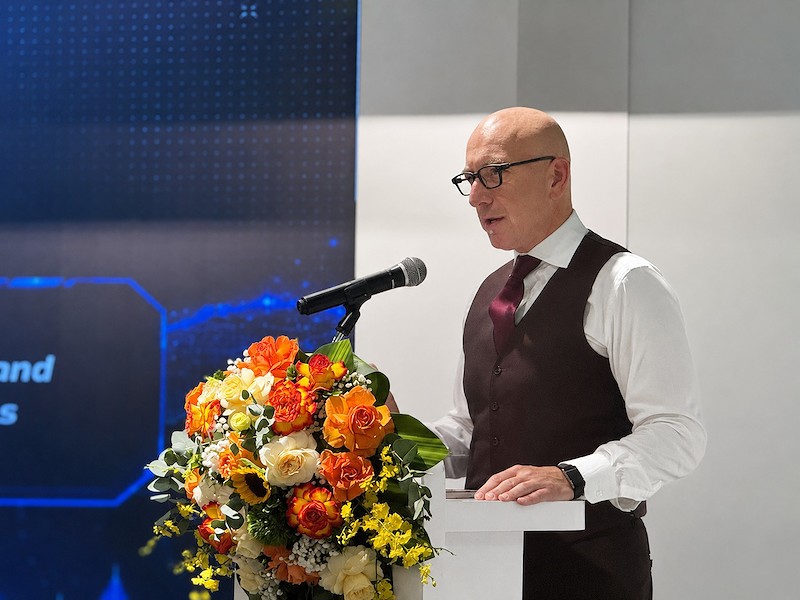
Mr. Gianluca Pettiti, President and Chief Operating Officer and President of Products & Technology at Thermo Fisher Scientific.
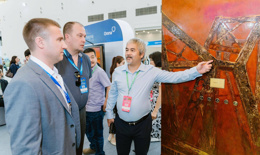
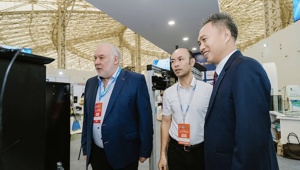
The coincidence in timing makes the story even more timely. On August 12, 2026, Deputy Prime Minister Hồ Quốc Dũng met with Mr. Gianluca Pettiti - President and Chief Operating Officer of Thermo Fisher Scientific - to discuss technology infrastructure, shared laboratories, and semiconductor and biomedical projects in Hanoi.
The following day, August 13, at a forum organized by the National Innovation Center (NIC), the two sides signed a memorandum of understanding (MOU) to develop a shared laboratory for semiconductors and biomedicine at NIC Hòa Lạc according to international standards. The corporation we are using as an example is not some unfamiliar name on the other side of the hemisphere, but one that is genuinely setting foot in Vietnam's high-tech ecosystem - bringing with it infrastructure demands that the elevator industry is partly connected to.
There are two points of intersection. At the first point, elevator enterprises are customers of analytical materials science - where Thermo Fisher's technology helps verify the quality of steel, cables, and structures. At the second point, elevator enterprises can become providers of vertical transportation solutions for the very high-tech factory ecosystems that corporations like Thermo Fisher represent. In between lies a larger lesson about quality culture.
The first point of intersection: When elevators are customers of materials science
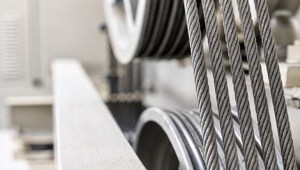
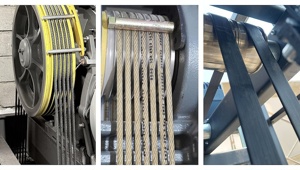
Every technician knows that elevator safety lies in materials. Steel wire rope, guide rail, safety gear, car frame, bolts, and welds - just one weak link with deviations in alloy composition, tensile strength, or coating can cause serious consequences. But after selecting the right type in theory, how do you know the actual batch of materials received matches what was declared?
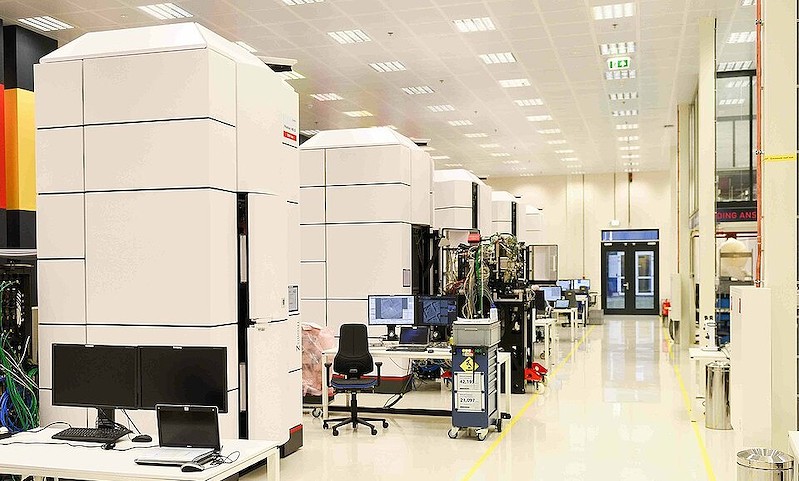
Thermo Fisher Scientific provides analytical tools, life science equipment, chemicals, consumables, and core pharmaceutical development services through major brands such as Thermo Scientific, Applied Biosystems, Invitrogen, Fisher Scientific, and Patheon.
This is the domain where Thermo Fisher's industrial analytical instruments segment serves metallurgy, aerospace, oil and gas, and manufacturing on a daily basis. The tools directly relevant to elevator materials include:
– Handheld XRF analyzers (X-ray fluorescence), notably the Niton series, determine the elemental composition of metals and alloys right at the warehouse, quickly and non-destructively - the core of "Positive Material Identification" (PMI): confirming the correct steel grade, instantly detecting non-conforming materials.
– Handheld LIBS analyzers (Laser-Induced Breakdown Spectroscopy) can measure carbon content, thereby accurately distinguishing carbon steel from low-alloy steel - a decisive factor for steel used in cables and load-bearing structures.
– Optical Emission Spectrometers (OES) and Wavelength Dispersive X-ray Fluorescence (WDXRF) spectrometers in the ARL series installed in laboratories, providing comprehensive composition analysis at high accuracy — tools for steel mills and fabrication facilities.
– Electron microscopy for "failure analysis": examining microstructures to trace the root causes of breakage, metal fatigue, corrosion, or weld defects when incidents occur.
Imagine a familiar scenario: a maintenance unit discovers abnormal wire breakage in a traction cable after only a few years, much earlier than expected service life. With the naked eye, it is difficult to know whether the cause is load, maintenance, or the cable itself not meeting standards from the start. A handheld XRF analyzer immediately checks the steel composition; failure analysis using electron microscopy determines whether it is metal fatigue, corrosion, or a metallurgical defect - the conclusion both helps address the incident correctly and serves as evidence to trace supplier responsibility and prevent similar issues in other projects.
In practice, these devices serve four functions. Incoming material inspection: independently verify the steel grade and alloy of cables, rails, and accessories before assembly, rather than simply trusting the seller's paper certificates. Countering counterfeit and substandard materials: detect non-conforming batches in just seconds. Coating control: measure the thickness of anti-corrosion zinc coating on components. Incident investigation: failure analysis to find the root cause of breakdowns, serving both technical and legal purposes.
This direction aligns with policy. Now that elevators belong to the high-risk goods category subject to import quality inspection, material verification capability is no longer a "nice-to-have" option but is gradually becoming a compliance requirement and competitive advantage. Enterprises that proactively control the origin and composition of materials will stand firmer before both regulators and customers. At this point, the elevator industry stands in the role of a buyer of inspection technology.
Not Just Equipment: A Lesson in Quality Culture
If we stop at just a list of machines, we will miss the most important lesson. What makes Thermo Fisher is not each individual machine, but an operating philosophy: quality is built through continuous improvement at every stage, rather than only inspecting at the final step. For a corporation serving biomedicine — where errors can cost lives — quality must be a system, with data, traceability, and standardized processes.
The elevator industry can absolutely hold itself up to this mirror. Safety cannot rely solely on a periodic inspection according to QCVN 02:2019/BLĐTBXH or QCVN 32:2018/BLĐTBXH, but needs to be nurtured as a culture throughout: from selecting and inspecting incoming materials, installing according to design documentation, to periodic maintenance and data traceability. The Vietnam Elevator Association's TCCS 01:2023/VNEA baseline standard on general safety requirements in the management, use, maintenance, and repair of elevators is precisely a step in that spirit: turning quality into a repeatable, measurable, and improvable process.
The Second Point of Intersection: When Elevators Are Suppliers to High Technology
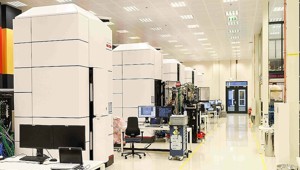
In the reverse direction, Thermo Fisher itself - along with its network of pharmaceutical, biological, and semiconductor customers - operates large-scale factory systems, cleanrooms, and laboratories. Biopharmaceutical manufacturing facilities following the CDMO (Contract Development and Manufacturing Organization) model, sterile plants, or filtration-purification lines all require specialized vertical transportation solutions. This is where elevator enterprises can participate as high-value suppliers.
Elevator needs in biopharmaceutical and cleanroom environments have their own particularities, clearly different from residential elevators:
– Cleanroom elevators: smooth stainless steel surfaces, minimizing particle generation and accumulation, compatible with HEPA air filtration, easy to clean and disinfect according to the cleanliness class of the room.
– GMP compliance (Good Manufacturing Practice): materials and design meeting sanitary requirements, resistant to cleaning chemicals, with validation documentation — a mandatory standard in pharmaceutical manufacturing.
– Freight elevators and specialized lifting equipment: transporting bulky equipment, heavy loads, or transferring sterile materials between clean zones while still controlling cross-contamination.
The opportunity lies in the investment shift trend. Vietnam is strongly attracting FDI (foreign direct investment) into high technology: pharmaceuticals, biology, and especially semiconductors - factories that also need vertical transportation meeting cleanroom standards. And this is no longer a hypothetical scenario: the shared laboratory at NIC Hòa Lạc along with the semiconductor and biomedical manufacturing projects that Thermo Fisher is studying to deploy in Hanoi are precisely international-standard facilities about to take shape - where elevators and freight lifts meeting cleanroom and heavy equipment transport requirements are needed.
Vietnam's elevator industry is already familiar with specialized products such as hospital elevators and firefighting elevators; moving into the cleanroom-GMP segment is a logical expansion, targeting a market with high technical barriers and less pressure from cheap goods squeezing profit margins.
Three Lessons for the Elevator Industry
From the two points of intersection above, three actionable lessons can be drawn.
First, upgrade material inspection and traceability capabilities. Now that elevators belong to the high-risk category, proactively verifying the composition and quality of cables, rails, and structures - using one's own equipment or through accredited testing laboratories - both meets regulatory trends and serves as a shield against legal and reputational risks.
Second, build quality as a system, not a one-time inspection. Safety is determined across the entire chain - from incoming materials, installation, maintenance, to data traceability. Standardizing processes according to TCCS 01:2023/VNEA and digitizing maintenance records are concrete steps.
Third, get ahead of the cleanroom and high-tech elevator segment. The wave of FDI into pharmaceuticals, biology, and semiconductors is creating demand for GMP-cleanroom-standard solutions, an opportunity for Vietnamese enterprises to rise to high-value segments, escaping the price war in the popular segment.
More broadly, these movements are tied to the spirit of Resolution 57 of the Politburo on breakthroughs in the development of science, technology, innovation, and national digital transformation. The shared laboratory model itself - where enterprises, institutes, and universities access modern equipment at reasonable cost and time rather than each unit investing separately - is also a valuable suggestion for the elevator industry itself: members can form shared material testing infrastructure under the coordination of the Association, both inspecting incoming materials and supporting incident investigation for the entire industry, avoiding scattered resources while still raising the quality baseline.
The story of a life sciences corporation, seemingly unrelated to elevator shafts, ultimately opens up practical suggestions. In an increasingly integrated and technologized economy, the boundaries between industries are blurring - and businesses that know how to learn from outside their own field will be the ones that go the furthest.