

Not long ago, I accompanied an expert from the Institute of Applied Elevator Engineering to conduct a comprehensive assessment of the elevator system for a building in Hanoi. The building had not been in use for long, and the elevator was from a major brand, worth several billion dong.
In the machine room, the original control cabinet had been removed and placed in a corner. In its place was a brand-new electrical cabinet from a popular Chinese brand on the market.
The expert stood looking for quite a while, then said: "The elevator isn't at the end of its life yet, but people are forcing it to die."
I call this "elevator strangulation."
Each elevator brand has its own communication 'language'
If we compare an elevator to a body, the control system is the brain. It receives signals from the cabin, floor doors, landing call buttons… processes them, and then issues commands for the entire system to operate. But not every brain speaks the same language. Each manufacturer builds its own language, with its own software, communication protocols, and diagnostic tools.
In terms of technical accessibility, systems can be divided into closed and open systems. In a closed system, the manufacturer controls the software, tools, and technical access rights. Open systems use public and standardized protocols, allowing integration of compatible devices from multiple suppliers. CANopen Lift, based on the CiA 417 specification set, is a typical example.
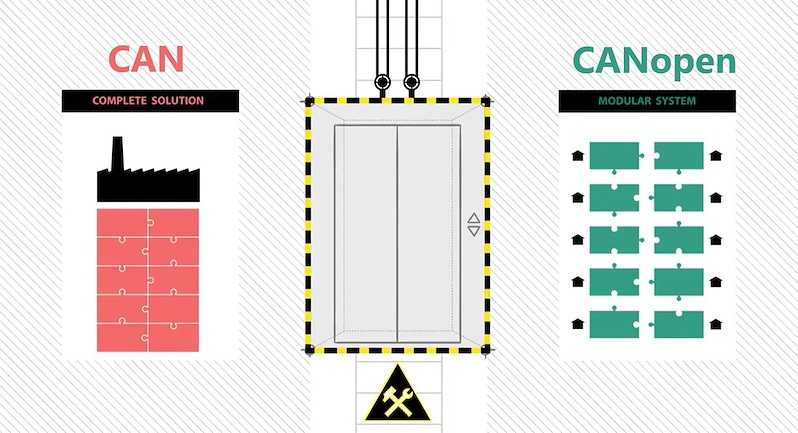
Closed control system (left) is a turnkey solution where all components are supplied and controlled by a single manufacturer. Open control system (right) is a modular system sharing a common communication language standard, CANopen-Lift, supporting compatibility of devices from multiple suppliers.
But whether closed or open, maintenance still requires trained personnel with appropriate documentation and tools. Without these, the control cabinet becomes a "black box," and every repair is a gamble.
That is also why authorized maintenance is often more expensive than the general market rate, because owners pay for things they cannot see, beyond the usual cleaning, manual labor, and lubrication…
From "not knowing how to fix it" to "must upgrade" or "conspiring to create work and split the money"
Finding it expensive, many investors and building management boards switch to hiring outside units at lower prices. In quite a few projects, the elevator was installed by company A but handed to company B for maintenance, while technicians at company B have never been trained on that elevator line.
Not to mention the practice of quoting low prices to win contracts and then cutting quality. Savings on paper are not necessarily real savings.
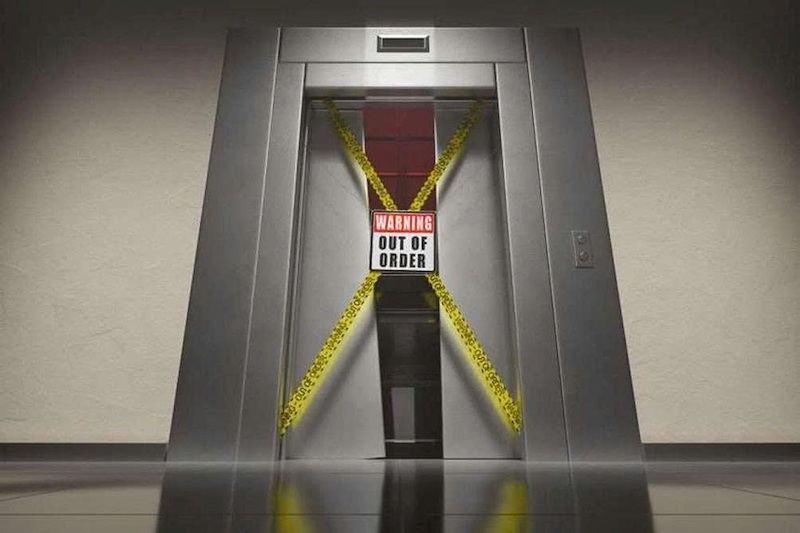
The elevator continuously reports errors and sometimes stops entirely. The service unit cannot find the cause, and instead of admitting its own capability limitations, they offer a more palatable conclusion: the elevator is old, the control system is "outdated" and needs modernization.
The subsequent scenario is quite familiar. The elevator continuously reports errors, the maintenance team cannot read the error codes, does not know how to fix them, and cannot find suitable spare parts. After several failed repairs, they propose "replacing the brain entirely," meaning replacing the entire control system, with very convincing reasons: the old system is "outdated," components are "hard to find."
Worse still, there are cases where the elevator is operating normally, but the service unit and the management unit collude to "fabricate" replacement items for personal gain, splitting the money, causing already limited resources to be spent in the wrong place.
The proposed new control systems are usually popular lines such as Monarch, STEP… or more commonly Fuji, introduced with all sorts of origins from South Korea, Japan, Thailand… but actually all manufactured in China, widely sold and familiar to many technicians. For the maintenance team, bringing the elevator to a system they are familiar with is convenient in every way: easy to fix, easy to replace parts,…
To be fair: modernization is not wrong. In cases where the elevator has exceeded its design life, is seriously degraded, or suitable spare parts are no longer available… then modernization and control system replacement is the right thing to do.
What is worth discussing is that in many cases, a system is still operating well, but becomes broken simply because the maintenance provider does not know how to fix it and thus persuades the user to let it "retire."
One removal, many payments
The cost of incompetence does not stop at the new cabinet. Replacing the control system can lead to replacing signal transmission circuit boards, landing call panels, door controllers, and other original equipment that is no longer compatible.
Costs continue to arise even when the old cabinet sits quietly in the corner of the machine room.
If integration is not synchronized, the original elevator becomes a patchwork system: mechanical parts from one brand, electrical system from another. A few years later the elevator malfunctions again, requiring yet another round of replacement.
Owners not only pay for new equipment but also lose the untapped value of the old equipment, plus the days the elevator must be stopped and additional repair costs.
Therefore, the problem of choosing a maintenance provider must be calculated over the entire elevator lifecycle, not just the first-year contract price. Before signing, owners need to assess the unit's real capabilities: experience with that specific elevator line, the qualifications and training certificates of technicians, access to documentation, tools, and spare parts…
Missing a yardstick
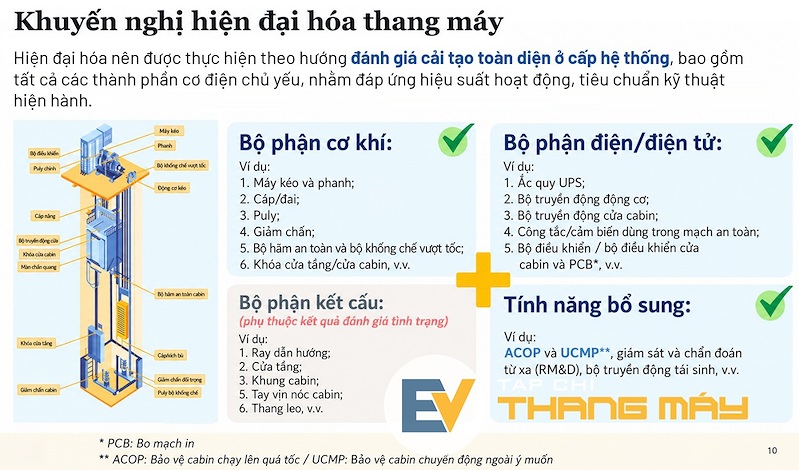
When does an elevator component need replacement, and when does the entire system need renovation and modernization? To date, owners and management units still lack a unified technical basis to answer this. The mechanism for independent assessment before high-value replacement decisions is also unclear, even when the money spent comes from the budget or residents' maintenance fund.
Lacking both a technical yardstick and an independent arbiter… In that gap, technical service units often play all three roles: diagnosing faults, proposing solutions, and earning revenue from replacements. The management and user side lacks the expertise to counter; or even "shakes hands" to conspire in creating work and splitting money.
A replacement proposal dossier with all the required signatures can still lead to a wrong decision.
To provide a reference basis for the parties, the Vietnam Elevator Association has published TCCS 01:2023/VNEA – General safety requirements in the management, use, maintenance, and repair of elevators.
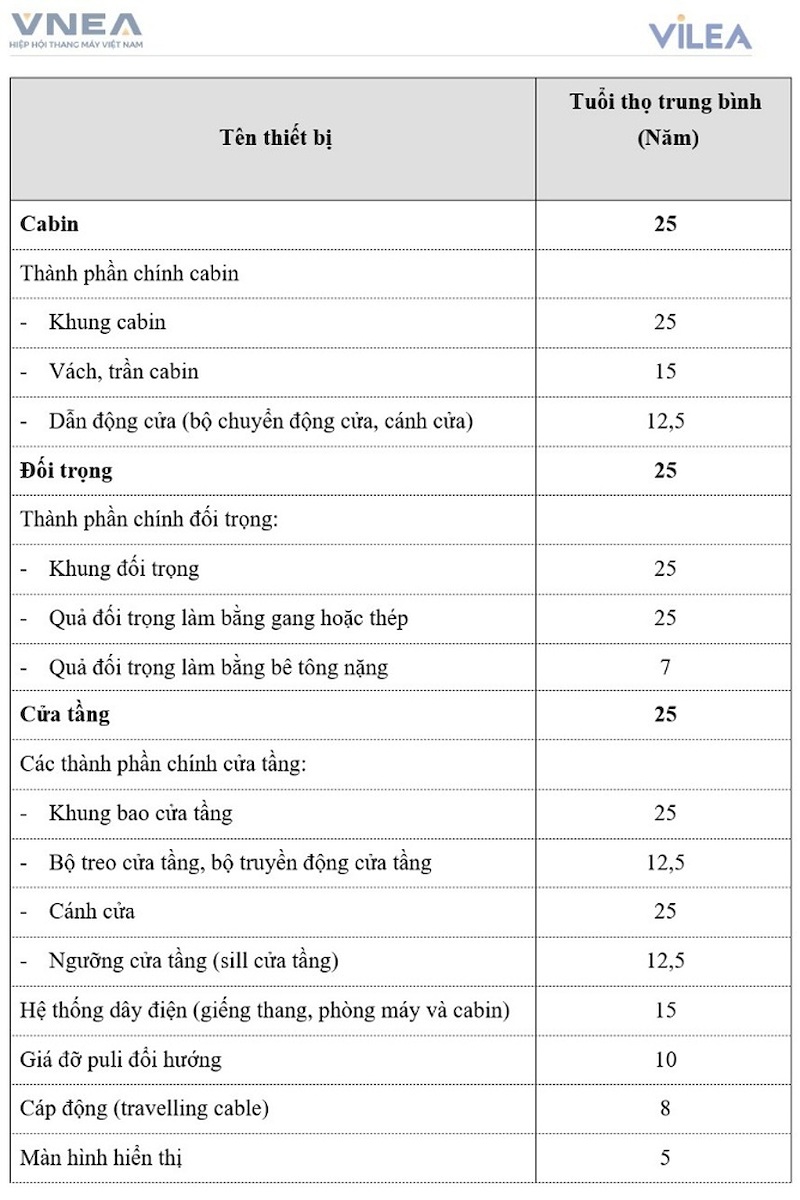
This standard sets requirements for service units and personnel, and also recommends the lifespan of rapidly wearing components and the lifespan of main elevator equipment, such as an average of 10 years for control cabinets and 15 years for traction machines.

Some notable contents being proposed in the draft TCVN include attaching identification codes to newly installed elevators for information retrieval and equipment history to serve management, use, maintenance, and repair; and planning major repairs and modernization based on equipment condition.
The draft national standard TCVN - Requirements for operation, maintenance, repair, and use of elevators, expected to be issued in 2027, also recommends lifespans for rapidly wearing components and main equipment.
This is the basis for parties to plan assessments and inspections to carry out elevator replacement and modernization work.
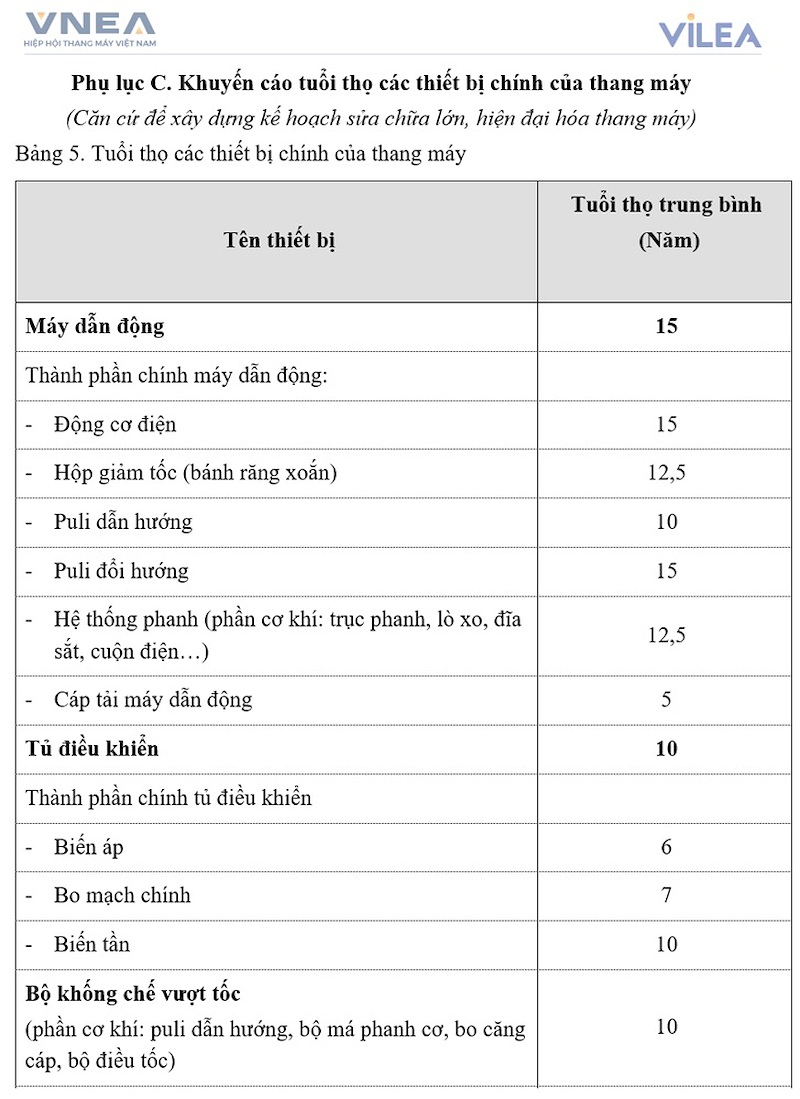
Table of recommended lifespans for main elevator equipment in the Base Standard TCCS 01:2023/VNEA for the purpose of providing a basis for developing plans for major overhaul and modernization of elevators
The control cabinet that had to "retire early" in that Hanoi building that day still sits in the corner of the machine room, having not lived out the life it was designed for. Each such cabinet represents an unnecessary waste that society must bear.
How many buildings are quietly paying that cost? To date, no one has tallied it!