



Why Can't We Afford to Wait?
Three pressures are simultaneously bearing down on the elevator industry.
Regulatory pressure: from August 2026, elevators and escalators will be included in the List of Risk Goods, classified as high-risk, accompanied by quality inspection requirements for imported goods.
Safety pressure: increasingly stringent requirements for inspection, maintenance, traceability, and the quality of equipment and materials demand that the industry be capable of collecting, storing, and exploiting data systematically.
Competitive pressure: cheap imports are eroding profit margins.
These three pressures may appear distinct, yet they all converge on a common denominator: the capacity to process data and reorganize workflows – precisely one of the domains where AI can deliver transformative change.
At the 2026 Business Forum, National Assembly Deputy Hồ Đức Thắng cited estimates from Access Partnership: Vietnamese enterprises could capture approximately USD 79.3 billion in economic benefits by 2030 if AI solutions are widely adopted, nearly 12% of projected GDP. A Microsoft–LinkedIn survey found that 88% of Vietnamese knowledge workers surveyed have used generative AI, higher than the global rate of 75%.
But Mr. Thắng cautioned about three bottlenecks: tool costs are falling rapidly while enterprise transformation costs remain high; data is abundant but usable data is scarce due to fragmentation and lack of standardization; and the pace of AI experimentation outpaces the pace of organizational change – many organizations have issued AI accounts to employees but remain unclear about which processes need to change and who is accountable. "Using AI is adopting technology. Redesigning how we work is what creates productivity," he emphasized.
These three bottlenecks are particularly relevant to the elevator industry: Maintenance data is scattered across technicians' notebooks, site photos, or work chat groups. Data exists in abundance but has not necessarily become structured, connectable, and exploitable. Therefore, the first challenge of AI in the elevator industry may not be choosing which AI model to use, but rather standardizing data and identifying the right problem to solve.
The Singapore Lesson: Seven Links That Cannot Be Separated
An analysis of Singapore's technology development journey offers a noteworthy observation: an invention can shine in the laboratory only to fade in the budget corridor, the procurement procedure, or outside the market door. Singapore bridged that gap with a relatively seamless policy chain comprising seven links: national direction, long-term investment, shared infrastructure, controlled experimentation, government as first user, enterprise scaling, and trust built from the outset.
These seven links can absolutely be applied at the scale of an industry association – an entity that simultaneously shapes direction, builds shared infrastructure, organizes experimentation, and pioneers adoption. Therefore, the core imperative for associations is to view AI as an ecosystem that must be built and operated in a synchronized manner, rather than as a standalone technology product.
Shared infrastructure is one example. Singapore developed shared platforms so that multiple agencies and enterprises could leverage them together. For the elevator industry, "shared infrastructure" can begin with far more practical elements: a unified data dictionary, unified error coding, a unified maintenance record structure, an updated standards and regulations database, and a standardized incident data repository…
Controlled experimentation is also a noteworthy lesson. A sandbox is not a regulatory exemption zone, but rather a space where technology can be tested within defined scope, timeframe, and conditions, with oversight mechanisms and contingency plans when results fall short of requirements.
Another lesson is that the government or industry organizations can become the first user, thereby creating a real-world testing environment and establishing initial standards. Once the model demonstrates effectiveness, enterprises then have a basis for scaling.
This suggests a path forward for the elevator industry: it need not necessarily begin with large-scale AI projects, but should start with smaller problems that have data, users, and measurable outcomes.
What Problems Can AI Solve for the Elevator Industry?
AI is not a solution for every problem. The value of AI emerges only when it is applied to a specific problem, with sufficiently good data and processes for people to use the results.
Predictive Maintenance: From Reactive to Forecast-Based
Vibration data, motor current, door open/close counts, traction machine temperature, error history, component replacement history… if collected continuously and analyzed over time, these can help identify anomalies before failures occur.
At that point, maintenance can gradually shift from a "scheduled maintenance" or "fix when broken" model to one based on the actual condition of equipment and predictive risk assessment. However, predictive maintenance does not start with AI. It starts with equipment having appropriate sensors, data being collected continuously, incident history being fully recorded, and that data being interconnectable.
Inspection and Quality Control
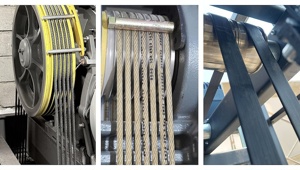
Computer vision assists in detecting signs of cable strand breakage, rail wear, and door misalignment from images and video; combined with material data to trace origins and detect substandard components – a capability directly tied to new compliance requirements.
Operations and Rescue
An AI assistant can help technicians quickly look up schematics, error codes, technical guidance, or on-site handling procedures.
Data from past incidents, if digitized and standardized, can also become a "knowledge repository" to assist technicians in similar situations.
In rescue operations, AI can assist in categorizing initial information, determining priority levels, and supporting coordination. But the final decision must always rest with humans and operational procedures.
Training and Skills Development
AI can also serve as a tool to support technician training. Instead of learning only from static textbooks, learners can interact with a knowledge base, incident scenarios, and technical situations.
A technician of the future does not necessarily need to become a data engineer. What is more essential is that they know how to ask AI the right questions, verify results, identify misinformation, and know when AI must not be used to replace professional judgment.
Data – The Most Critical "Infrastructure" for AI in the Elevator Industry
If one priority must be identified before deploying AI, it is data standardization. An AI system, no matter how advanced, will struggle to produce reliable results if trained on incomplete, inaccurate, or inconsistent data.
For the elevator industry, the data foundation can be built from the following components: a unified dictionary of error codes, equipment types, and maintenance categories; a standard structure for maintenance records; data on components, materials, and origins; a regularly updated repository of standards, regulations, and technical documentation; and the operational, maintenance, and replacement history of each product…
Data standardization does not mean that enterprises must disclose all business data. What matters is establishing clear boundaries between proprietary enterprise data, data that can be shared, and data that can become a shared asset for the entire industry.
This is not merely a technical challenge, but also directly involves ownership, security, accountability, and data governance mechanisms. Only when this foundation is established in a synchronized, transparent, and secure manner will AI have sufficient basis to develop at an industry-wide scale.
If this foundational layer can be resolved, AI will then have the basis to develop at an industry scale.
The Role of Professional Associations: From Networking to Building Shared Infrastructure
In this transformation process, industry representative organizations can play a connecting and catalyzing role in addressing issues that individual enterprises struggle to resolve effectively on their own.
First is standardization: Develop and recommend data sets, terminology, error classification methods, and record structures tailored to industry-specific characteristics.
Next is experimentation: Create conditions for a number of enterprises, buildings, or facility management units to jointly test AI solutions within defined scope, with evaluation criteria and oversight mechanisms.
Third is enhancing technology absorption capacity. Many enterprises, especially small and medium-sized ones, do not lack software but lack people who can correctly identify the problem, evaluate vendors, and calculate return on investment. A shared expert model can help enterprises reduce experimentation costs, mitigate risks from errors, and accumulate experience to share across the industry.
Alongside this is the establishment of AI governance principles. For an industry directly tied to human safety, governance must be established from the outset and throughout the entire adoption process.
Where to Begin?
The 90-day roadmap proposed by Mr. Hồ Đức Thắng – National Assembly Deputy, Member of the National Assembly's Committee on Culture and Social Affairs – at the "2026 Business Forum: Removing Bottlenecks, Making the Digital Economy a Growth Driver in the New Era," held on August 14 in Hanoi, can be applied to the elevator industry: the first 30 days to inventory resources and select 2–3 priority problems; the next 30 days for controlled experimentation; the final 30 days to evaluate results and decide whether to scale, adjust, or stop.
Three problems that can be prioritized include: standardizing and digitizing maintenance records under a common data framework; building an AI assistant to help technicians look up standards and regulations; and piloting predictive maintenance on a group of voluntarily participating elevators. These are all problems with manageable scope, measurable outcomes, and the potential to create shared assets for the industry.
The implementation process should be guided by three principles throughout: choose the problem first, then the tool – start with bottlenecks that are driving up costs, degrading quality, or creating safety risks; treat data as a strategic asset of the industry – standardized with clear access permissions; keep humans in the final decision-making position – AI assists, but does not replace professional responsibility.
From the Singapore story, one message can be drawn: autonomy does not necessarily mean owning every technology, but rather mastering the capacity to select, integrate, verify, replace, and take responsibility. A strong association in the AI era is not measured by the number of technologies it holds, but by its ability to embed technology into the daily operations of the industry. At that point, AI will be present in every maintenance shift, every inspection report, and every safe elevator journey each day.
KEY REFERENCE FIGURES
- USD 79.3 billion: potential economic benefits AI brings to Vietnamese enterprises by 2030 (Access Partnership estimate), nearly 12% of projected GDP.
- 88%: proportion of Vietnamese knowledge workers surveyed who have used generative AI, compared to 75% globally (Microsoft – LinkedIn).
- From 4.2% to 14.5%: proportion of Singaporean small and medium-sized enterprises using AI during 2023–2024; large enterprises rose from 44% to 62.5%.
- 90-day roadmap: 30 days to inventory and select 2–3 problems; 30 days for controlled experimentation; 30 days to evaluate for scaling, adjustment, or discontinuation.