

On October 29, 2026, the European Commission announced the results of testing 40 elevator buffer samples under JACOP 2025 – a coordinated program for monitoring product compliance with standards. Of these, 28 out of 33 polyurethane (PU) buffer samples failed to meet technical requirements, while all 7 hydraulic samples passed.
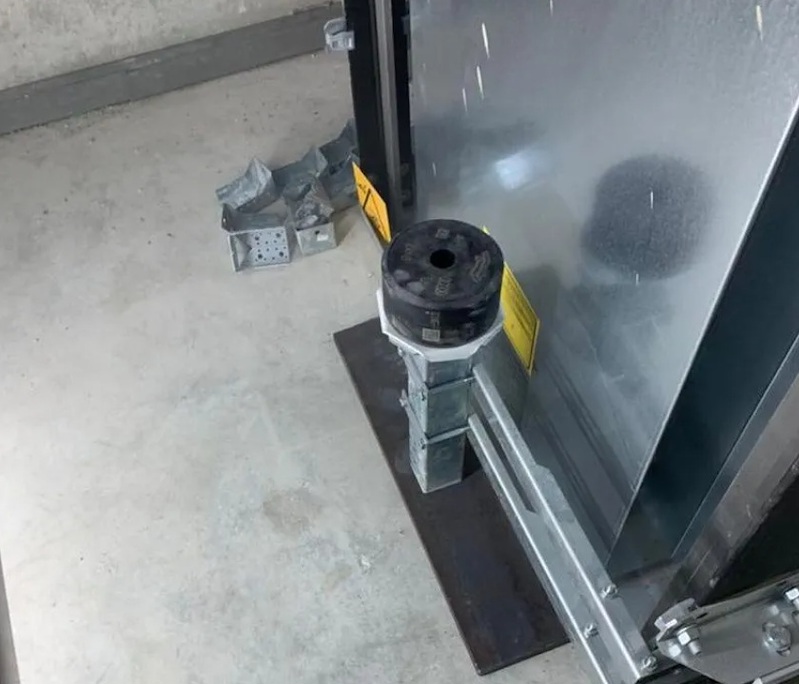
The majority of PU elevator buffer samples randomly tested by European authorities do not ensure safety and fail to meet European standards.
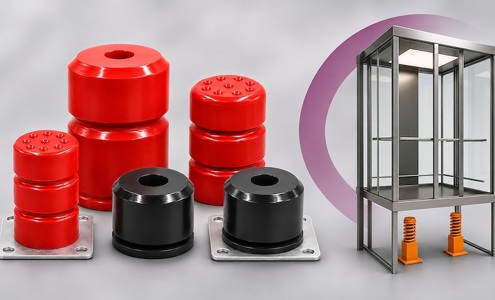
Buffers are safety components installed at the bottom of the elevator pit, designed to absorb impact when the car or counterweight travels beyond the lowest stopping position during normal operation. They are the last line of protection in abnormal situations, aimed at limiting injuries to users, maintenance personnel, and equipment damage.
Most PU Buffers Fail Safety Testing; All Hydraulic Buffers Pass Standards
Eight market surveillance authorities in Cyprus, Germany, Malta, the Netherlands, Sweden, and Switzerland collected 40 random buffer samples from the market between December 2025 and February 2026.
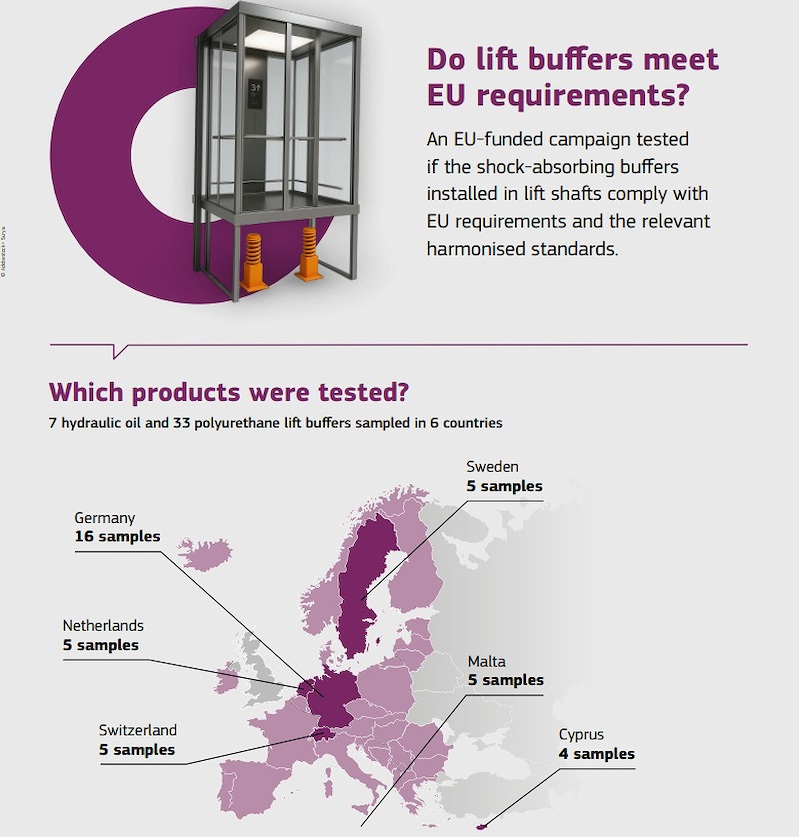
Of these, 20 samples were purchased online, 11 samples were obtained directly from manufacturers, and 9 samples from retail stores. The campaign focused on two main types of buffers:
- Energy-absorbing buffers with non-linear characteristics, commonly known as PU buffers;
- Energy-dissipating buffers, commonly known as oil-based hydraulic buffers, which use fluid to absorb and dissipate energy.
Most products were manufactured in Germany (29 samples), followed by China (7 samples) and Italy (4 samples).
Laboratory testing was conducted from February to April 2026, in accordance with the applicable requirements of EN 81-20:2020 and EN 81-50:2020.
The tests examined key safety parameters, including the ability to control braking acceleration during compression; the recovery time of the buffer to its normal position; and any damage or permanent deformation after testing.
For hydraulic buffers, the laboratory also checked for fluid leakage. The results showed:
BUFFER TYPE | TEST STANDARD | NUMBER OF SAMPLES TESTED | NUMBER OF SAMPLES FAILING TECHNICAL REQUIREMENTS | FAILURE RATE |
PU BUFFER | EN 81-50:2020, clause 5.5.3.2 | 33 | 28 | Approximately 85% |
HYDRAULIC BUFFER | EN 81-50:2020, clause 5.5.3.1 | 7 | 0 | 0% |
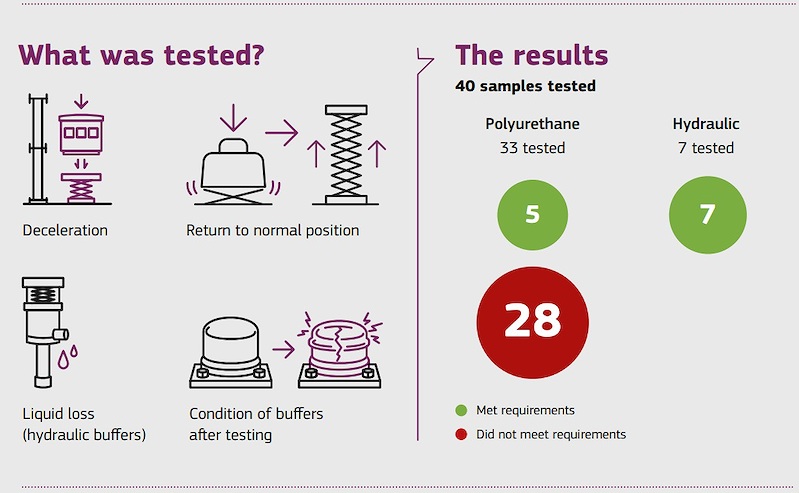
Buffers are responsible for slowing speed and cushioning impact when the elevator car travels beyond the lowest stopping position. If the car is stopped too abruptly, the force exerted on passengers and elevator components increases.
In testing, PU buffer samples primarily failed because the maximum braking acceleration exceeded the permissible limit of the safety standard. In other words, the test object decelerated too abruptly upon impact with the buffer.
In addition to technical testing, authorities also examined markings, labels, and documentation. There were 15 samples, equivalent to approximately 38%, with deficiencies such as missing or non-compliant CE marking; missing contact information for the manufacturer's EU-based contact or authorized representative; and missing instructions in the required national language.
Sales Ban on 5 PU Elevator Buffer Samples, Requests for Explanation and Supplementary Documentation
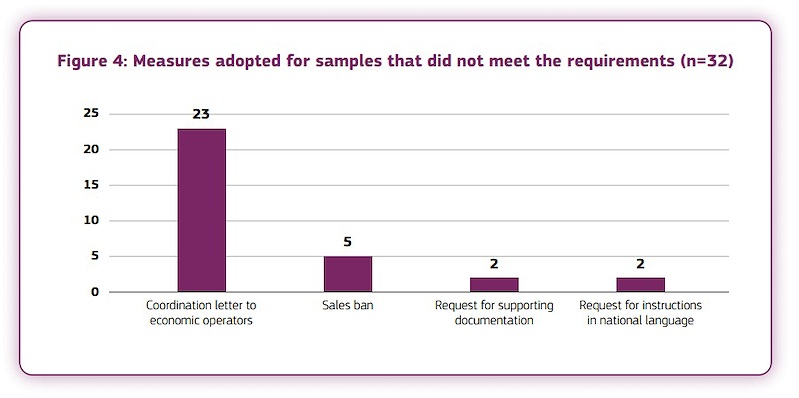
Based on the inspection and testing results, European market surveillance authorities contacted 23 economic operators to notify them of the results, request feedback, and outline proposed corrective measures. Further measures will be decided based on these responses.
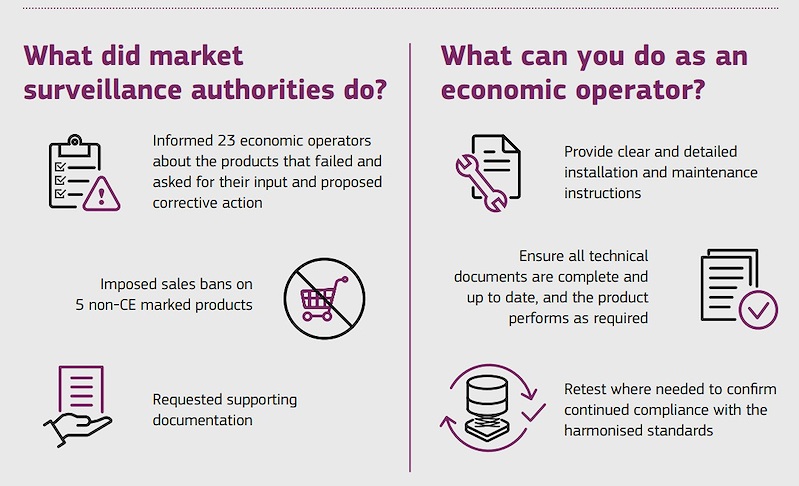
Additionally, 5 sales bans were imposed, including on PU buffer products sold through Chinese e-commerce platforms.
At the same time, two cases involving test samples from companies based in China were required to provide supporting documentation, including relevant type-examination certificates and evidence of production monitoring activities; and two cases were required to supplement instructions in the national language.
Market surveillance authorities recommend that manufacturers and other economic operators maintain strict production controls at the factory, monitor consistency between product batches, and conduct re-testing whenever there are changes to materials, product composition, or manufacturing processes.
Manufacturers, importers, and distributors must ensure that products bear the CE marking, are accompanied by an EU Declaration of Conformity, and include clear installation and maintenance instructions in the required national language. Technical documentation must be complete, up to date, and consistent with the declared specifications.
"The overarching message from this testing campaign is very clear: elevator safety components may be out of sight, but they play an essential role in public safety. Ensuring that these components comply with EU requirements is essential to maintaining trust in the single market," said Vanessa Capurso, Policy Officer at DG GROW.
The testing activities were carried out within the framework of the 2025 Joint Action on Product Compliance (JACOP) campaign in the EU and the countries of the European Free Trade Association (EFTA). JACOP supports market surveillance authorities in harmonizing working methods, coordinating product testing, identifying risks, and enforcing corrective measures. A total of 11 product groups were assessed.