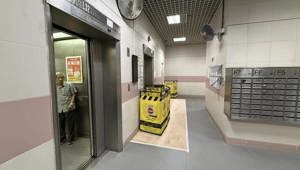




Recently, a video clip from a surveillance camera was circulated on social media, recording an incident at a construction site in Vietnam equipped with a hoist-type lifting device.
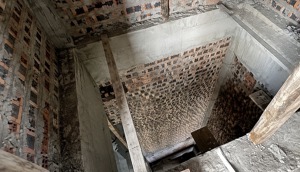
The footage shows the device's movement zone completely exposed, with no shaft walls, protective enclosure, or barrier fencing. Adults and children could walk freely directly beneath the device's operating area.
The video captures a woman stepping into and standing within the movement zone below the hoist while the device was elevated. A few seconds later, the device descended while she had not yet left the danger zone, causing the victim to be struck and trapped beneath the equipment.
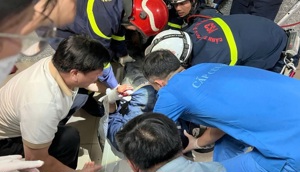
Bystanders immediately rushed over to assist the victim. However, the video does not provide complete information regarding the time, specific location, or the subsequent condition of the injured person.

The device may be inexpensive, but the price paid when safety is neglected is very high
Warning of safety risks from equipment that does not comply with standards and regulations
Currently on the market, especially at private residential renovation projects, some lifting devices are advertised under names such as "mini elevator," "home elevator," or "backpack hydraulic elevator."
These products are introduced with various structural designs: cabins with fully enclosed walls, half-height cabins, or L-shaped lifting platforms without cabin walls. Some devices are even installed in completely open spaces, with no shaft or fence to prevent access to the movement zone.
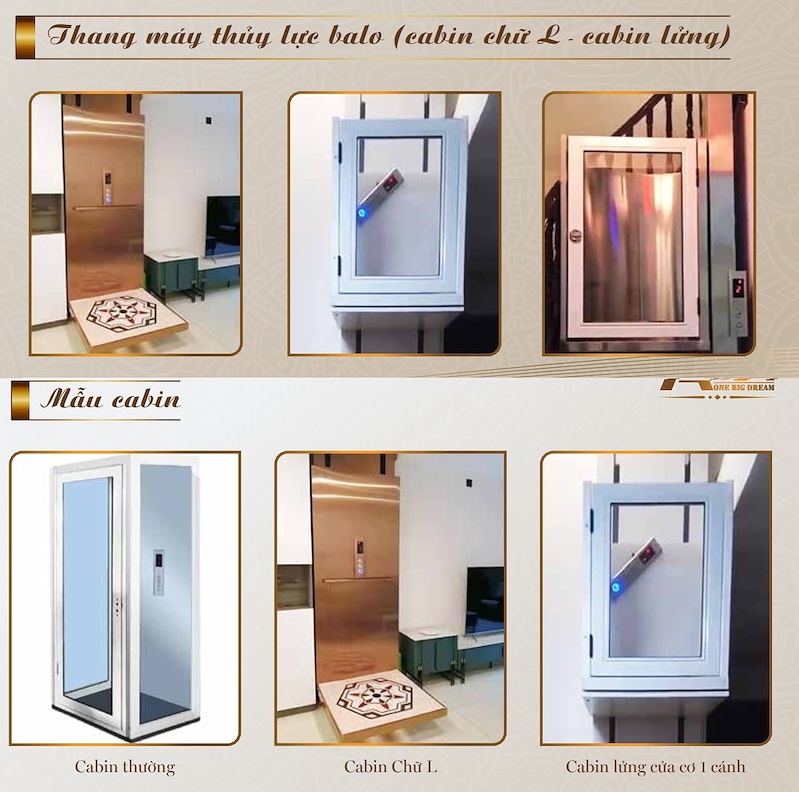
These devices, which are not elevators and do not meet current safety standards and regulations, are heavily advertised at low prices, attracting significant consumer interest
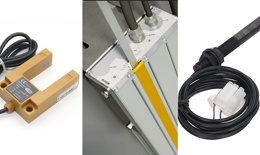
According to sellers' advertisements, this type of product is equipped with collision sensors under the cabin floor; when an object touches the underside of the cabin, the elevator will immediately stop. Nevertheless, this remains extremely dangerous in the event of a collision sensor malfunction, which could lead to serious accidents such as crushing or severing limbs or other body parts.
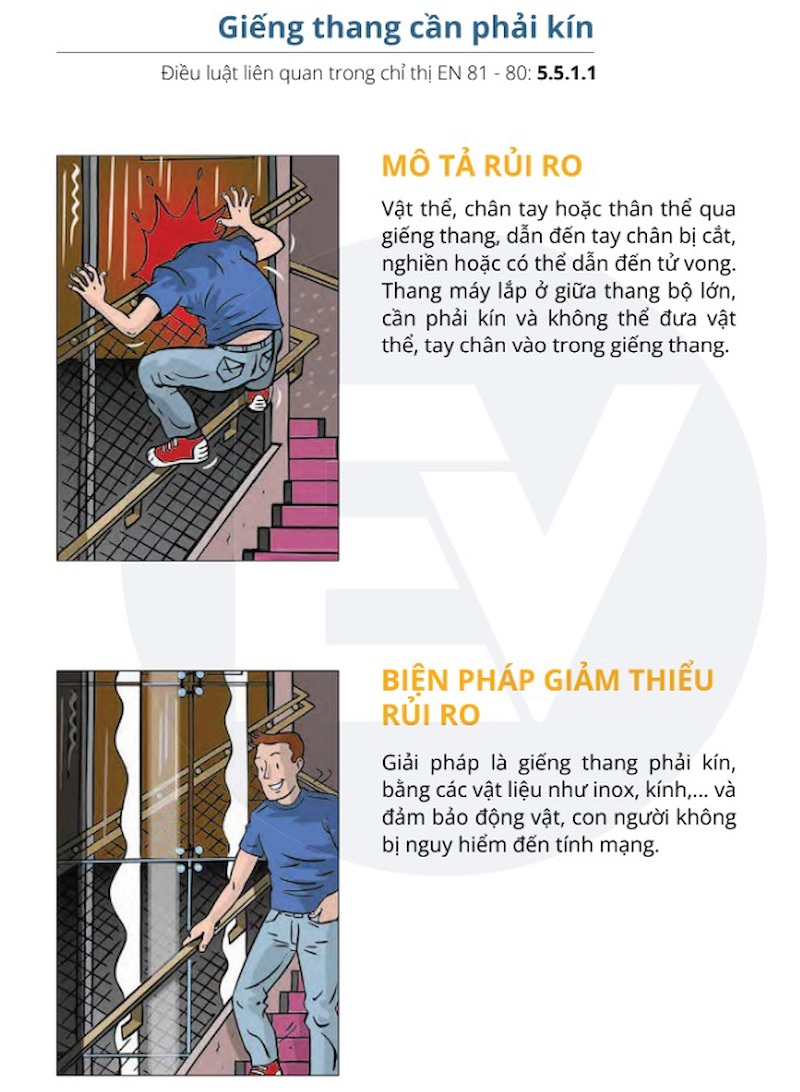
The general safety principle for lifting devices is to prevent people from accessing moving parts.
Under current regulations QCVN 02:2019/BLĐTBXH on occupational safety requirements for elevators; QCVN 32:2018/BLĐTBXH on occupational safety requirements for home elevators; TCVN 6396-20/50 specifying safety requirements for the design, installation, and testing of elevators (equivalent to EN 81-20/50), devices called elevators must have a fully enclosed shaft or a partially enclosed shaft with stringent technical requirements specified in clause 2.1.4.6 of QCVN 02:2019/BLĐTBXH, and must also comply with other technical safety criteria.
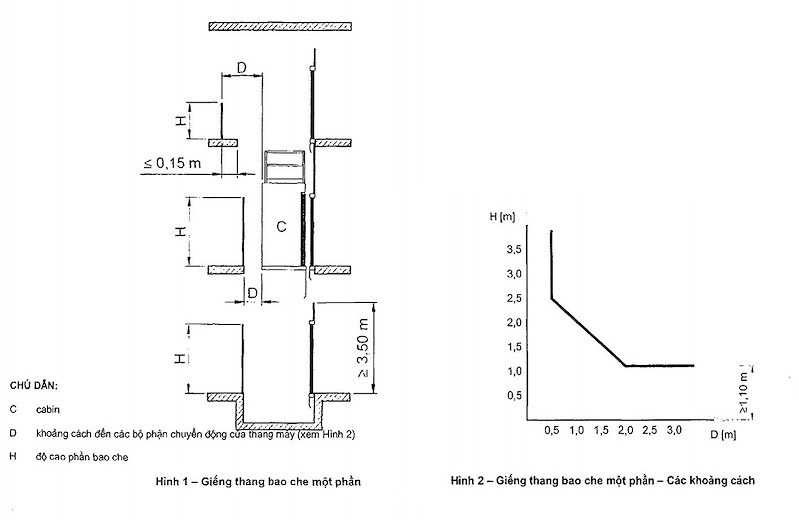
Dimension parameters for partially enclosed elevator shafts according to TCVN 6396-20:2017 on Safety requirements for the design and installation of lifts – lifts for passengers and goods
For partially enclosed shafts, clause 2.1.4.6 of QCVN 02:2019/BLĐTBXH on occupational safety requirements for elevators clearly stipulates:
The height of the enclosure at easily accessible locations must be sufficient to prevent danger from the moving parts of the elevator and to avoid affecting the safe operation of the elevator through direct contact or contact via handheld objects with elevator components within the shaft.
Additionally, the height of the enclosure wall must meet the following requirements:
1. At least 3.50 m on the landing door side;
2. At least 2.50 m on other sides and at a minimum horizontal distance of 0.50 m from the moving parts of the elevator.
If the distance to the moving parts exceeds 0.50 m, the 2.50 m height may be gradually reduced to a minimum of 1.10 m at a distance of 2.0 m.
Therefore, these devices cannot be called elevators, yet sellers still market them under the names "elevator" or "home elevator," "mini elevator," "backpack hydraulic elevator," with claims such as "meets TCVN standards," "safe," "cheap," or "modern technology."
For devices with exposed structures like the one in the video, such products cannot undergo conformity assessment or inspection. To protect user safety and prevent unfortunate consequences, regulatory authorities need to strengthen inspections, supervision, and strictly handle violations of elevator and lifting equipment safety regulations.
At the same time, the public should raise awareness and thoroughly research current elevator safety standards and regulations before deciding to install and use an elevator.
Choose elevator products with full conformity documentation and quality certifications, installed by a team of professional technicians, and ensure they undergo safety inspection before being put into use.