



October 14 every year is designated as World Standards Day by the International Electrotechnical Commission (IEC), the International Organization for Standardization (ISO) and the International Telecommunication Union (ITU), to honor the contributions and cooperation of experts and organizations worldwide in developing and applying standards.
Since 2021, IEC, ISO and ITU have agreed to implement a common theme "Standards for SDGs - Our shared vision for a better world." In 2026, the focus is on Sustainable Development Goal 7 - Affordable and Clean Energy.
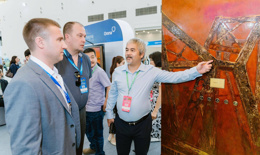
Attending the celebration were Deputy Minister of Science and Technology Le Xuan Dinh; Chairman of the National Committee for Standards, Metrology and Quality (STAMEQ) Nguyen Nam Hai; Director General of the Vietnam Agency for Radiation and Nuclear Safety Nguyen Hoang Linh; leaders of units under the Committee, along with representatives of ministries, sectors, associations, organizations and enterprises.
The program included four technical seminars on energy security; environmentally friendly materials; safe and sustainable food; artificial intelligence and smart cities. This was followed by the celebration and a discussion on the future of standardization in a changing world.
Attending the technical seminar and the Celebration of World Standards Day 2026, the Secretary General of the Vietnam Elevator Association presented a paper on Development Trends and Standardization of Elevator Safety Management.
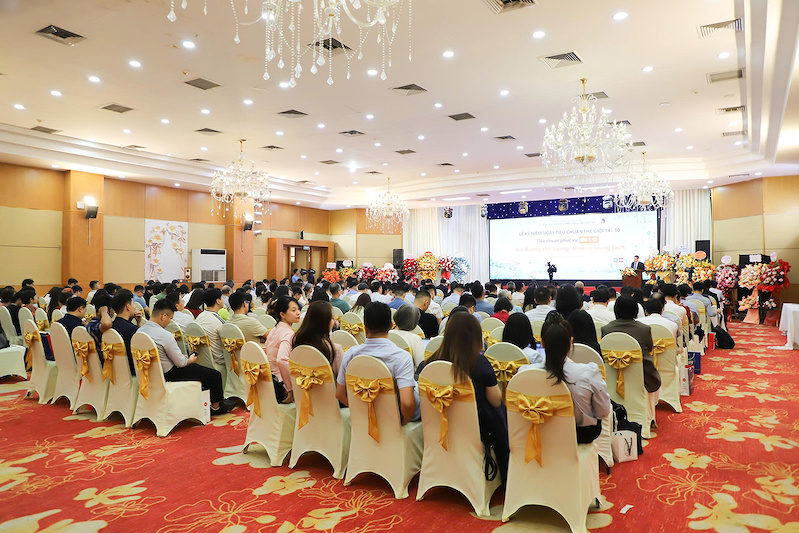
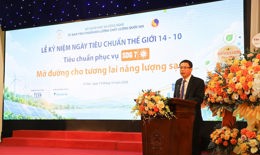
Celebration of World Standards Day on October 14 with the theme of Sustainable Development Goal 7 (SDG 7) – Affordable and Clean Energy.
From responsive standards to leading standards
In his opening remarks at the Celebration, Deputy Minister of Science and Technology Le Xuan Dinh said the message of World Standards Day 2026 is particularly meaningful as the world faces an urgent need for energy transition, emissions reduction and ensuring safe, reliable and affordable access to energy.
In that process, standards establish unified technical requirements, ensuring safety, quality and compatibility among devices, systems and technologies - from renewable energy integration, energy storage, electric vehicles and charging infrastructure to efficient energy use in production, buildings and cities. Standards on energy management systems such as TCVN ISO 50001 also provide enterprises with practical tools to improve energy efficiency and reduce costs.
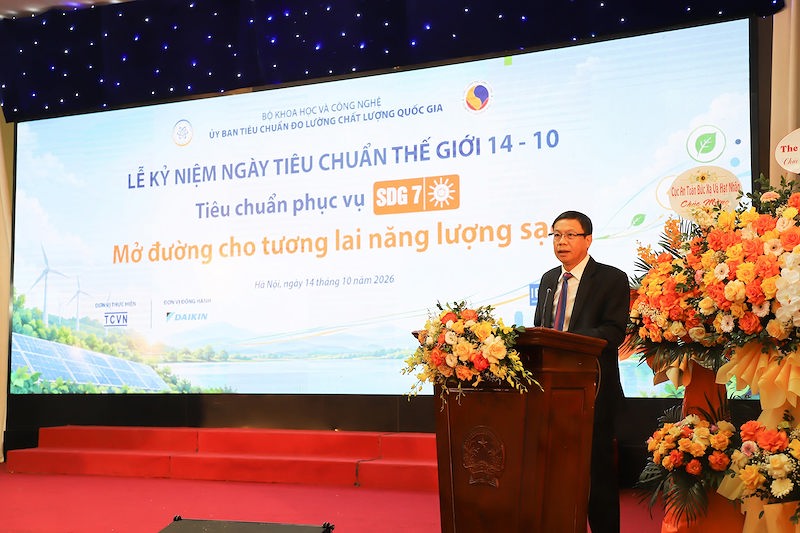
Deputy Minister of Science and Technology Le Xuan Dinh.
According to Deputy Minister Le Xuan Dinh, from the story of SDG 7, we need to look more broadly at the role of standards in the new development phase. Green transition, digital transformation, artificial intelligence and changes in global supply chains are rapidly generating new products, technologies and business models, bringing with them new requirements for safety, compatibility, traceability and sustainability.
This sets a principled requirement for Vietnam's standardization work: shifting from the mindset of developing standards after the market has formed to identifying trends, forecasting needs and preparing standards in advance for new fields; from responsive standards to leading standards.
This is a requirement for both the national standards system and the way Vietnam organizes its standardization activities.
The Deputy Minister added that as of October 2026, the TCVN system has more than 14,600 standards in effect, of which about 65% are harmonized with international and regional standards, with more than 180 national technical committees and subcommittees for standards.
This is an important foundation. However, scale is not the ultimate goal; more important is that standards must be of quality, timely, capable of forecasting and creating substantive value for enterprises, the market and society.
This year, World Standards Day is celebrated in the context that the Prime Minister has approved the National Standards Strategy for the 2026-2035 period under Decision No. 876/QD-TTg dated May 15, 2026, with very specific objectives.
Among them, the Strategy sets the goal of developing about 100 new TCVN standards serving strategic technologies by 2030 and having 100% of key technology fields with national technical committees corresponding to international technical committees; by 2035, about 30% of new TCVN standards serving new technologies, the digital economy and the green economy.
At the same time, Vietnam needs to gradually shift from being a recipient to a participant, contributor and shaper of international standards in fields where it has advantages and strategic interests.
According to the Strategy, the rate of TCVN standards harmonized with international and regional standards must reach 75% by 2030 and 80% by 2035; Vietnamese representatives must participate in 60% of the corresponding technical committees of ISO, IEC and ITU by 2030, moving toward 100% by 2035; and simultaneously assume the role of chair, co-chair or secretary of 1 to 2 international technical committees or working groups.
To achieve this, it is necessary to strengthen the participation of enterprises, research institutes and Vietnamese experts in international standardization activities.
Standardization of elevator safety management
At the thematic seminar "Artificial Intelligence and Smart Cities," Mr. Nguyen Huy Tien, Secretary General of the Vietnam Elevator Association and a member of Technical Committee TCVN/TC 178, presented the paper "Development Trends and Standardization of Elevator Safety Management: From Vertical Transportation Infrastructure to Comprehensive Safety Management Standardization."
According to Mr. Nguyen Huy Tien, the process of urbanization and the development of high-rise buildings requires viewing elevators as a component of vertical transportation infrastructure. The safe and continuous operation of this system directly affects daily life, production and service activities, and people's accessibility.
Along with changes in their role, elevators are transitioning from standalone electromechanical devices to systems capable of connecting, collecting and analyzing data. Information on door opening and closing cycles, load, motor temperature, vibration, current and fault warnings can support equipment condition monitoring, anomaly detection and appropriate maintenance planning.
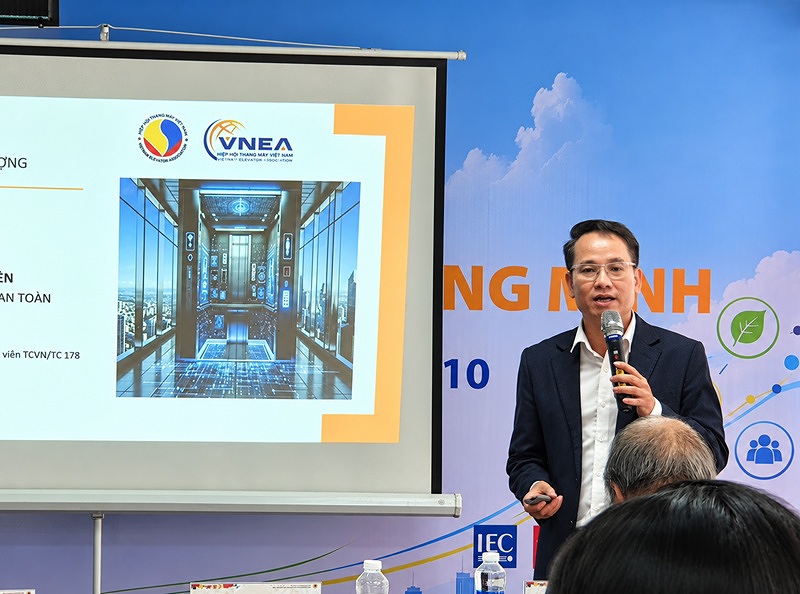
Mr. Nguyen Huy Tien - Secretary General of the Vietnam Elevator Association
From an energy perspective, Mr. Nguyen Huy Tien mentioned application directions such as regenerative drives, gearless motors and destination dispatch control. These solutions open up the possibility of improving transportation and electricity efficiency, while also creating a need to standardize methods for assessing the energy performance of elevators, escalators and moving walks.
When elevators connect with building management systems, data platforms or service robots, the scope of standardization also needs to extend to connection interfaces, cybersecurity and user data protection.
The adoption of technology and international standards must also take into account Vietnam's conditions, especially the humid tropical climate, flood risks and the specific characteristics of renovation projects.
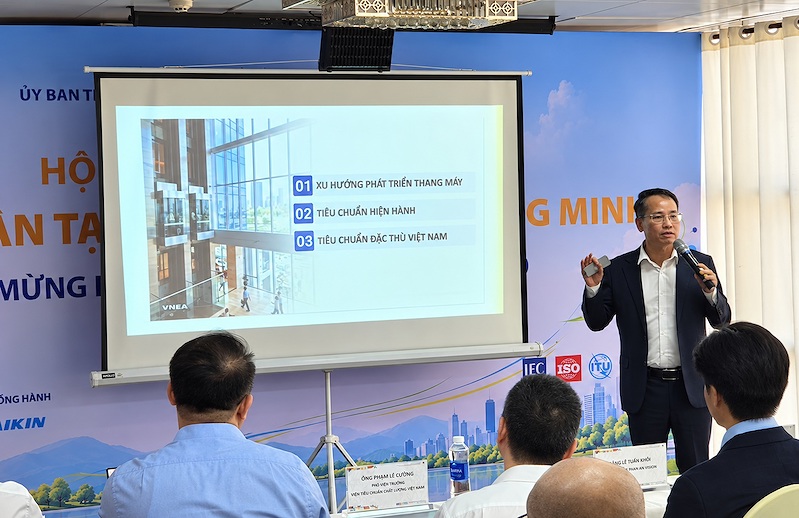
Mr. Nguyen Huy Tien emphasized the importance of building a national elevator safety management system
One key content emphasized by Mr. Nguyen Huy Tien is improving standards for the operational phase, including the operation, maintenance, repair and use of elevators.
This approach places equipment within its entire lifecycle, from inspection, maintenance and verification to repair, upgrade and modernization. At the same time, it is necessary to clarify the responsibilities of owners or management units, the competency requirements of service providers and technicians, as well as the role of users in complying with regulations and reporting abnormal signs.
In particular, the paper emphasizes that technician competency is a direct factor determining maintenance quality and equipment safety. Therefore, standardization needs to be linked with training, vocational skills assessment and enhancing the technical team's access to technology.
This is also the approach of the draft TCVN "Elevators - General requirements for operation, maintenance, repair and use," which is being developed by Technical Committee TCVN/TC 178 and is open for comments on the basis of developing and supplementing the baseline standard of the Vietnam Elevator Association.
To increase transparency in management, Mr. Nguyen Huy Tien proposed deploying a digital identification code for each device, supporting the lookup of inspection information, maintenance history and the responsible unit. At the same time, he recommended developing requirements on technician competency, rescue response time and gradually connecting data among elevators, maintenance units and management agencies.
The proposals aim toward a management system capable of monitoring equipment conditions throughout the usage process, supporting incident prevention and clearly determining responsibilities. Through this, standardization becomes a tool to improve service quality, operational efficiency and safety for elevator users.