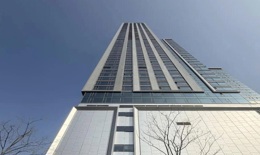




Citing information from the Fire Prevention, Fighting, and Rescue Police Division of the Hanoi City Police, Suc khoe va Doi song (Health and Life) Newspaper reported that at approximately 6:10 PM on August 6, the Fire Fighting and Rescue Team of Region No. 13 received a report of an elevator entrapment incident at a combined residential and commercial building at No. 1C Dinh Cong Thuong, Dinh Cong Ward.
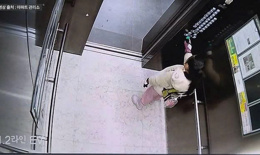
At the time of the incident, 13 people were trapped inside the cabin, including 5 adults and 8 children; among them were 2 foreign nationals.
Immediately upon receiving the information, the Fire Fighting and Rescue Team of Region No. 13 reported to the Command Information Center of the Hanoi City Police, and simultaneously dispatched 1 rescue vehicle, 1 fire truck, 1 fire motorcycle along with officers and soldiers to the scene.
The rescue force quickly deployed a plan to approach the elevator, while reassuring and instructing those inside the cabin to remain calm and avoid panic while awaiting rescue.
After an urgent response process, the authorities managed to open the elevator doors and bring all 13 people out safely.
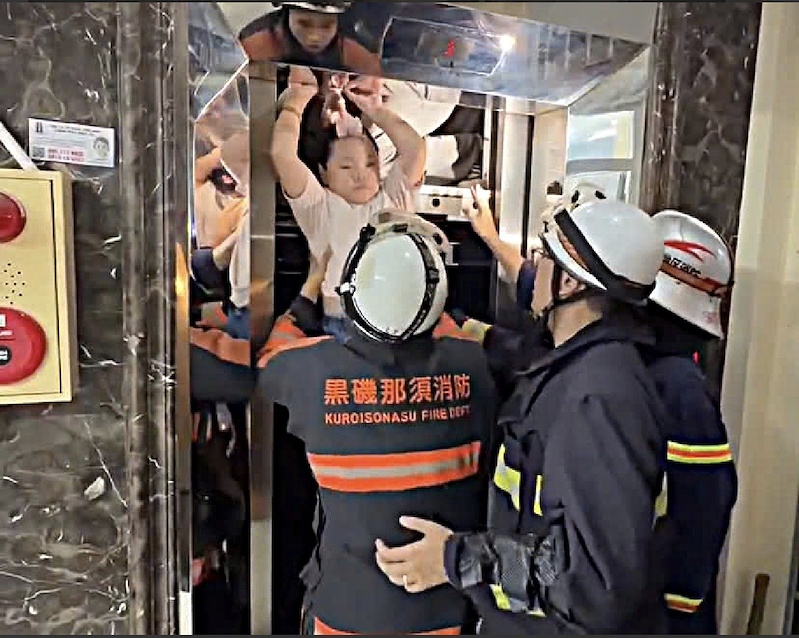
The elevator malfunctioned, trapping 13 people (5 adults and 8 children) in Dinh Cong, Hanoi.
However, images and videos recording the rescue process reported by Suc khoe va Doi song Newspaper show that the elevator cabin was in a misleveled state, meaning it was outside the permitted zone for opening the doors to carry out the rescue.
This is a situation with many potential risks; if the cabin moves unexpectedly, those positioned half inside and half outside the cabin could suffer dangerous accidents affecting their body and life, such as crushing or severing of body parts.
Observation from the video shows that the gap between the cabin floor and the top of the landing door is very small. Moving out is difficult and dangerous. At certain points, even adults struggled to get out.
Another notable detail is that the lower part of the cabin in this incident was not equipped with a door apron. This is a component that shields the gap between the cabin and the hoistway wall, helping to limit the risk of people or objects falling into the hoistway when the cabin stops at a misleveled position.
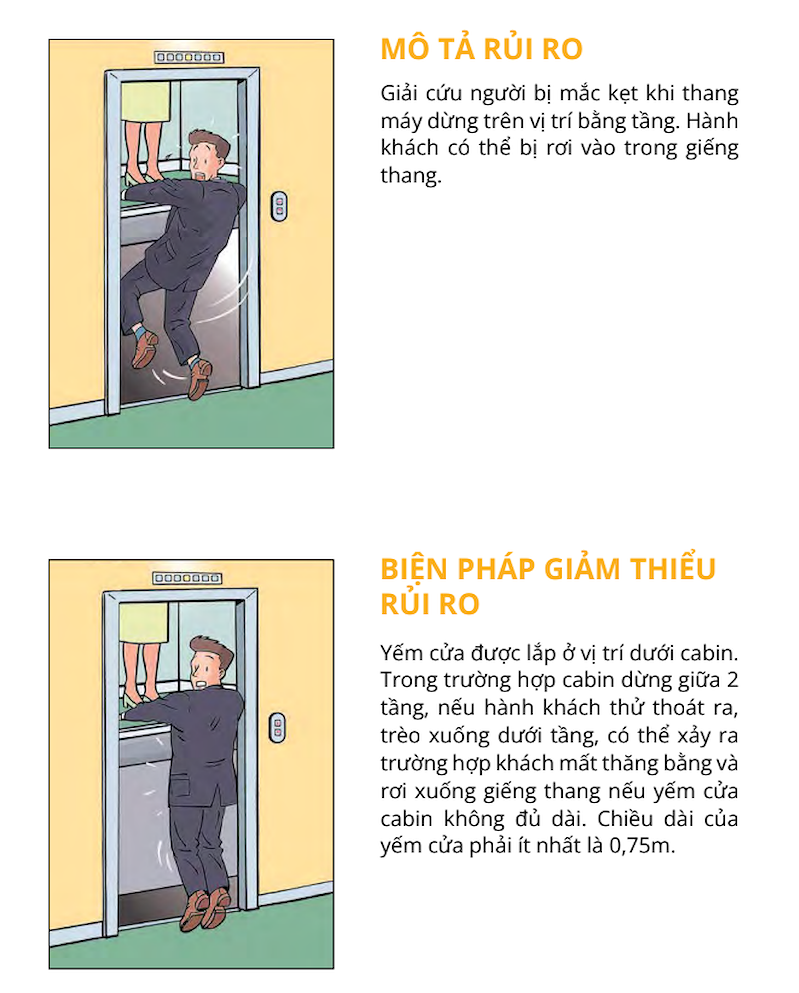
According to the National Technical Standards (TCVN), designing a door apron with a minimum length of 0.75m can minimize the risk of a person falling into the cabin when escaping while the cabin is not level with the floor. However, this measure also does not ensure safety if the cabin drifts.
Therefore, in elevator rescue operations, it is absolutely necessary to comply with the technical regulations regarding bringing the cabin to the safe zone (not more than 20cm above or below the landing floor), using a specialized key to open the elevator doors, and only then allowing people to exit.
In cases where the landing door and car door are mechanically driven and operate simultaneously, the unlocking zone limit may extend up to a maximum of 0.35m above and below the floor level of the landing.
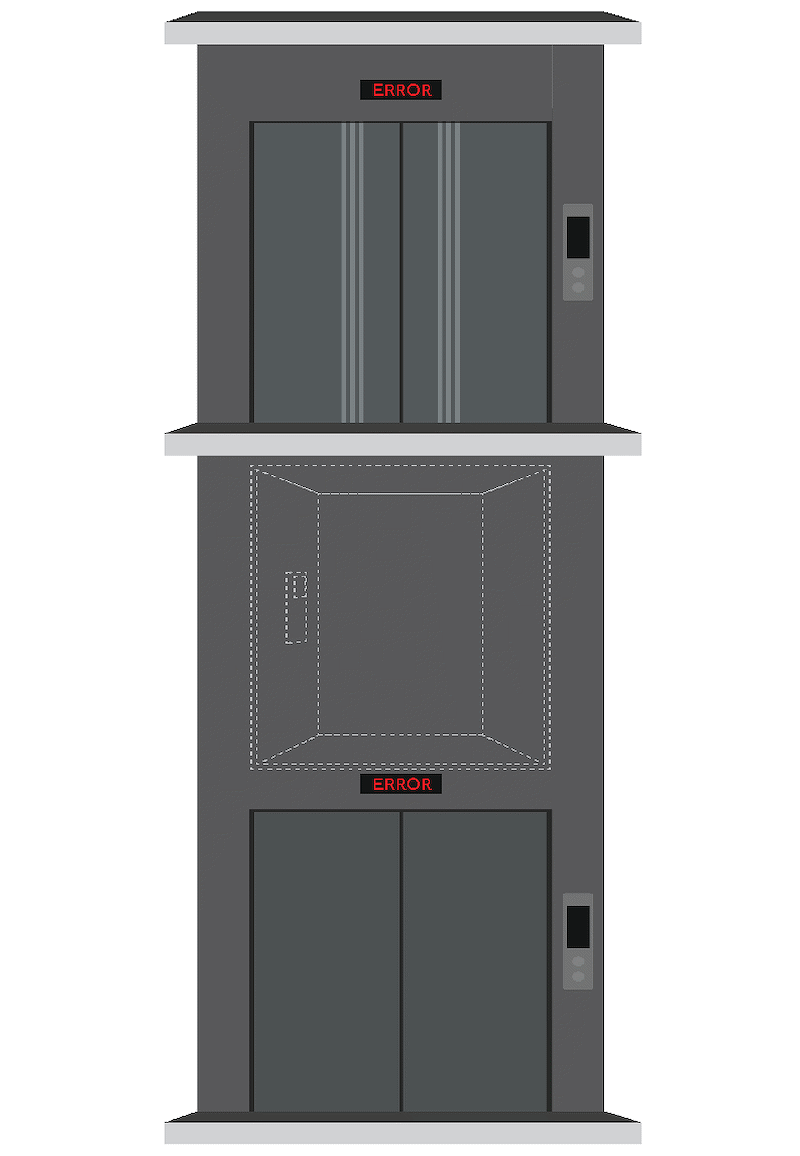
Illustration of a cabin within the leveling zone; elevator rescue operations can be carried out easily by using the landing door key to open the landing door and car door, bringing trapped people out.
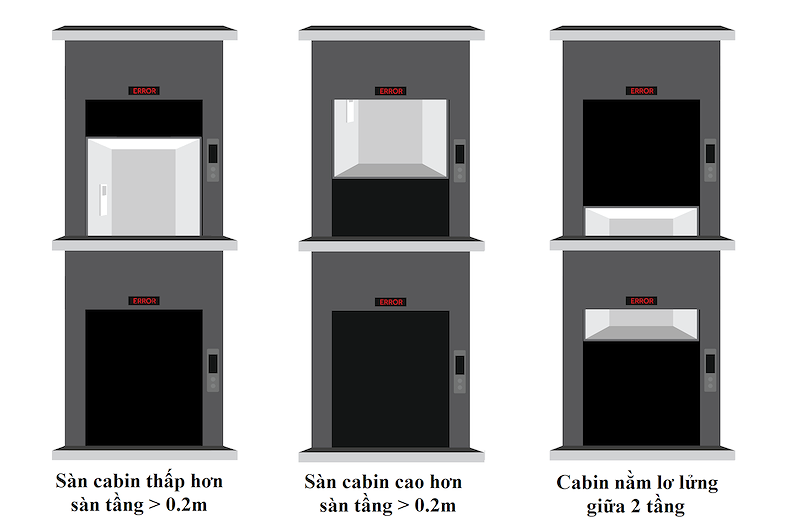
In these three cases, the cabin is stuck at a position outside the leveling zone, where the elevator car floor is more than 0.2m away from the landing floor. These are unsafe situations for opening the elevator doors due to the risk that a person exiting the elevator cabin could fall into the hoistway.
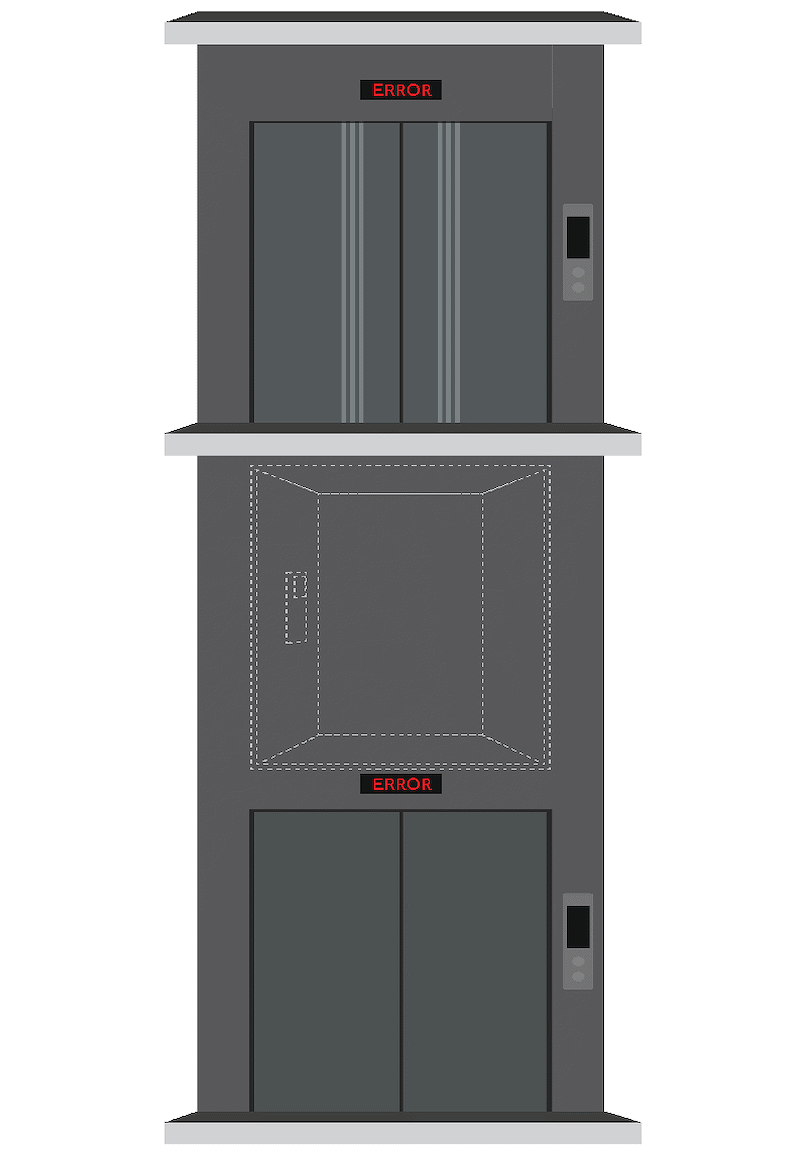
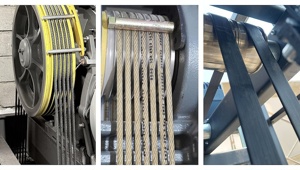
For buildings with large floor height designs, the cabin may become stuck at a position between two floors where the landing doors of both floors cannot reach the car door; prying open the doors from inside cannot bring trapped people out and also carries the risk of falling into the hoistway