



The Unquantified Gap
Currently, Vietnam lacks a public, unified dataset on the number of elevator technicians, professional qualifications, scope of work, and the distribution of workforce by locality. Therefore, there is insufficient basis to accurately determine how many people the industry is short of.
International experience can be referenced to gauge the scale of demand. In South Korea, the law limits the number of elevators under routine maintenance to no more than 100 units per technical staff member per month.
Actual capacity depends on equipment distribution density, elevator type, age, usage frequency, maintenance requirements, remote monitoring capabilities, and each company's organization.
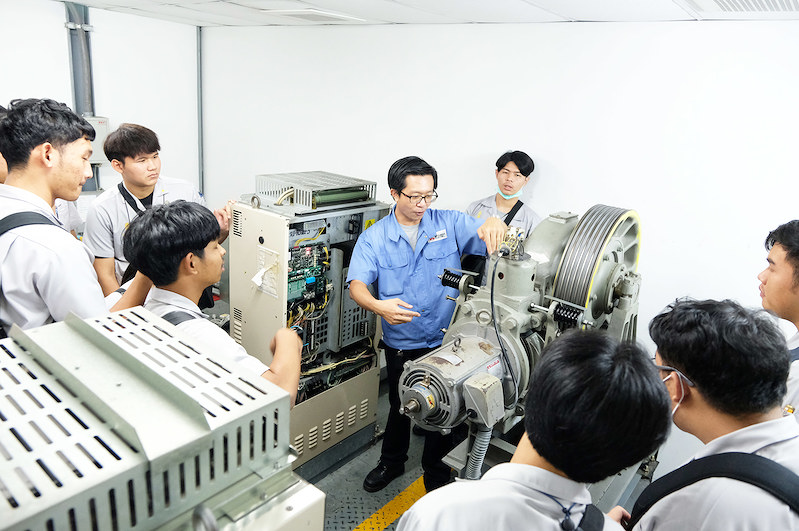
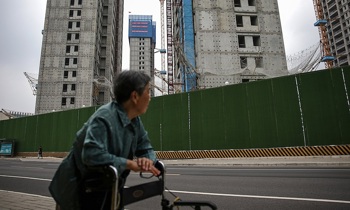
The number of elevators is increasingly rising, and many businesses face a shortage of technicians.
Vietnam has more than 480,000 units in operation, with new installation demand of approximately 40,000–45,000 units per year.
If the ratio of 100 units per person is used as a reference, nearly 500,000 elevators correspond to approximately 5,000 maintenance technicians. This figure does not include personnel for installation, major repairs, modernization, rescue, technical support, and quality management.
But maintenance is only one part of the problem that the elevator industry needs to solve.
An elevator ecosystem also requires installation, repair, modernization, rescue, technical support, quality management, and training personnel. According to the experience of many countries, total technical manpower is typically about 50–60% higher than the maintenance workforce alone.
This means that the scale of technical manpower that Vietnam's elevator industry actually needs today could be around 7,500–8,000 people.
By 2045, the Challenge Will Be Greater
If the pace of urban development continues, along with the expansion of social housing, high-rise apartments, hospitals, schools, and private homes with elevators, Vietnam could fully reach approximately 1.4 million elevators by 2045.
According to the same forecasting model, manpower demand will increase correspondingly.
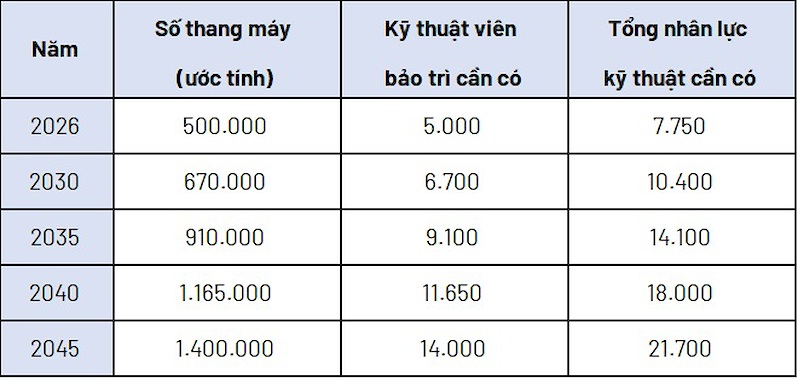
The above figures are not intended to be absolutely precise forecasts but to help visualize the scale. To determine the actual shortage, it is first necessary to simultaneously compile statistics on the number of units, the number of workers currently employed, and the capacity of each personnel group.
Although it cannot yet be precisely quantified, feedback from many businesses shows that recruiting installation, maintenance, and repair technicians is facing difficulties. Not a few companies have to recruit workers from electrical, electronics, mechanical, or mechatronics fields and then retrain them. This prolongs the adaptation period and adds further pressure on experienced technician teams.
In other words, the industry's challenge is not only a shortage of people but also the lack of a human resource development system that ensures workers have practical skills, safety knowledge, and the ability to work with various types of technology.
From "Labor Shortage" to Building a Human Resource Ecosystem
If this is viewed solely as a recruitment problem, the solution will stop at finding more workers. Meanwhile, international experience shows that elevator manpower is typically developed through a combination of foundational training, on-the-job practice at enterprises, competency assessment, and refresher training.
In the U.S., elevator technicians typically undergo multi-year apprenticeship programs combining technical instruction with paid on-the-job training. South Korea manages maintenance companies through requirements for technical personnel, specialized equipment, and limits on the number of elevators under responsibility.
The common thread of these models is linking training to actual work and maintaining skill updates throughout one's professional career.
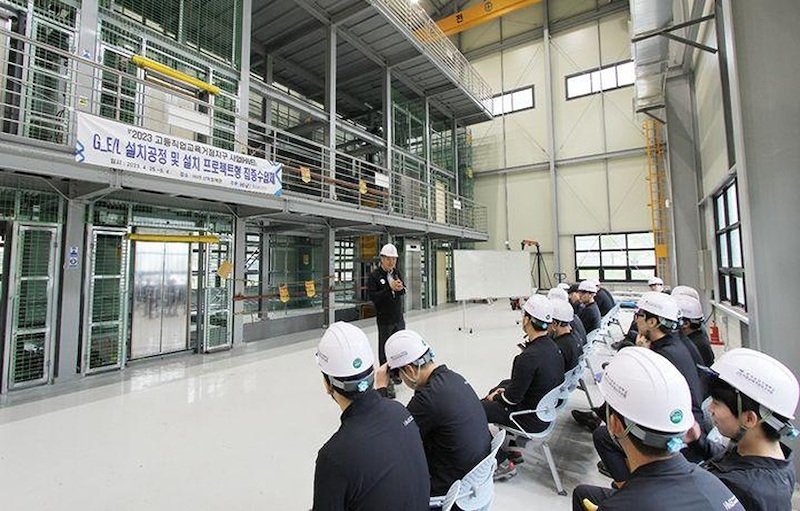
South Korea promotes cooperation models with enterprises to provide technical skills training for the workforce
Meanwhile, Gulf countries such as the UAE, Saudi Arabia, and Qatar regularly recruit experienced technicians from many countries but have very high requirements for practical skills, vocational certificates, and the ability to work independently. This shows that the international market does not lack demand but lacks qualified human resources.
Vietnam currently does not have an advantage in training scale but does have an advantage in its young workforce, a relatively good electromechanical foundation, and the ability to quickly absorb technology. If organized well, this could fully become a high-value-added profession in the future.
VNEA's Role: The Core Connecting the Human Resource Ecosystem
The Vietnam Elevator Association does not necessarily need to directly undertake all training activities but can serve as the focal point connecting regulatory agencies, vocational education institutions, enterprises, and international partners.
A model suitable for Vietnam is a tripartite partnership:
- Schools provide foundational knowledge, basic skills, and occupational safety training.
- Enterprises provide equipment, job sites, instructors, and internship positions.
- The Association participates in developing output standards, connecting experts, and coordinating quality assessment.
This model helps learners access real equipment while reducing retraining time for enterprises. In addition to new training, career transition programs can be developed for electromechanical students, industrial electricians, and technical workers with relevant experience.
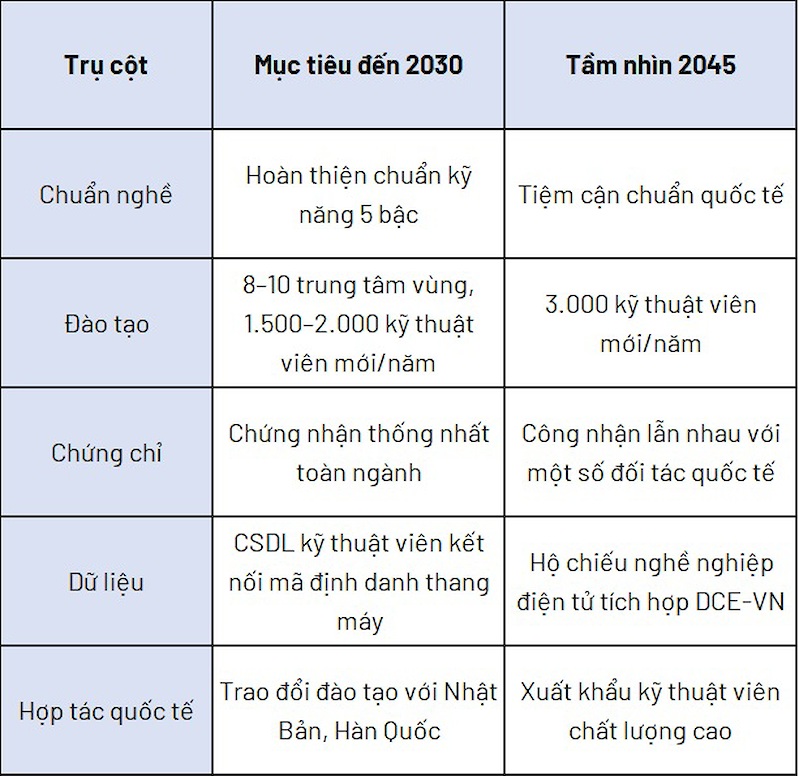
The key tasks that VNEA needs to implement include researching competency frameworks for each technical position; coordinating the development of training programs; developing skill assessment mechanisms in accordance with the law; surveying manpower demand; and promoting international cooperation.
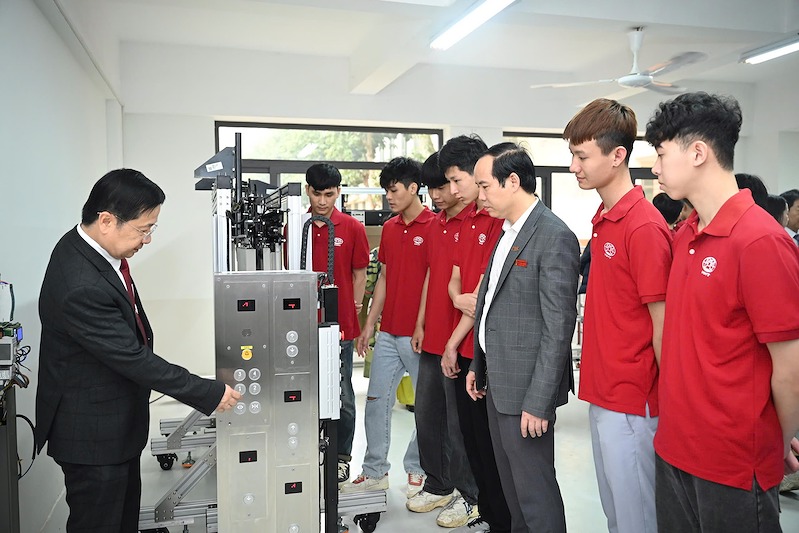
Elevator Training Center of the Vietnam Elevator Association
VNEA has now been strongly promoting this direction through the Elevator Training Center under the Institute of Applied Elevator Engineering, cooperating with Korea Elevator University, and linking domestic vocational schools and enterprises.
Alongside new training, career transition programs should be developed for electromechanical students, workers returning from Japan, South Korea, and Taiwan, discharged military personnel with technical expertise, and industrial electrician teams. These are human resources with a good foundation who need supplementary training to meet the industry's requirements.
From Domestic Training to Exporting Technicians
A highly noteworthy direction is to build Vietnam into a regional elevator technician training center. In the initial phase, the goal remains to meet domestic demand. But once the system of occupational standards, certificates, and training is complete, Vietnam can fully aim toward exporting high-value skilled labor.
Unlike general laborers, elevator technicians have good incomes, high qualification requirements, and stable career opportunities. After a period of working abroad, this workforce upon returning will bring back management experience, technology, and safety culture to continue contributing to the domestic industry.
Thus, human resources are no longer a "cost" but become a strategic national asset.
Human Resource Data – The Missing Piece of Digital Transformation in the Elevator Industry
In particular, the industry needs to build a human resource database. Each technician could have an electronic professional profile recording their training history, certificates, skill levels, and work experience.
This data will support enterprises in recruitment, training institutions in adjusting curricula, and regulatory agencies in forecasting manpower demand.