



This content was presented by the Hanoi People's Committee in the report on the Capital's Master Plan with a 100-year vision, submitted to the City Council for consideration at its 31st session.
According to the City People's Committee, the Capital Plan for the 2021-2030 period with a vision to 2050 and the General Capital Plan to 2045 with a vision to 2065 are no longer suitable for new development requirements. They need to be reviewed and adjusted to align with the adjustments to the National Master Plan.
On that basis, the city proposes to strategically reshape the spatial and urban infrastructure structure, while clearly defining cultural, historical heritage, and landscape spaces along major river axes such as the Da, Red, and Duong Rivers.
The scope of urban restructuring is defined from Beltway 3 inward, with priority given to implementation first in the Beltway 1 and Beltway 2 areas.
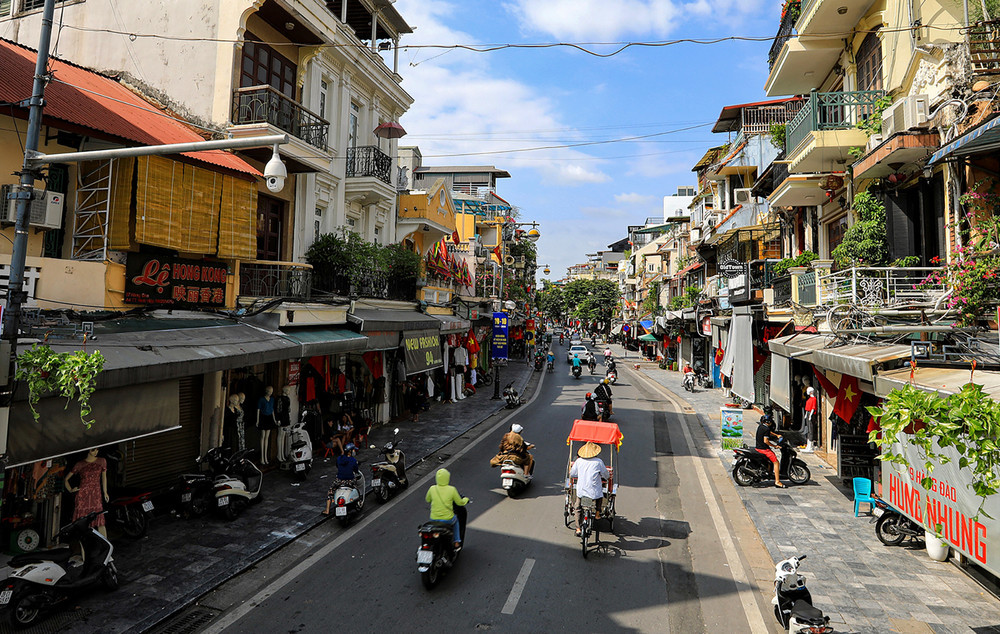
The restructuring process is expected to combine conservation, renovation, and refurbishment for areas and structures with historical, cultural, and distinctive architectural value. Key areas include: the Ba Dinh political-administrative center; the Hoan Kiem Lake area and its vicinity; the Old Quarter and Old Town; West Lake and its surrounding area; the area along both sides of the Red River with the main landscape axis.
Concurrently, the city proposes restructuring the population through the policy of inner-city population deconcentration. Residents subject to clearance and relocation will be partially resettled on-site, with the remainder relocated to new urban areas in growth poles such as Dong Anh, Gia Lam, and Hoa Lac.
It is estimated that the city needs to mobilize approximately 64.84 quadrillion VND to implement the overall planning adjustment for the 2026-2045 period.
Also during this period, Hanoi plans to relocate approximately 200,000 residents in the Red River area; 200,000 people in the West Lake area and its vicinity; and 42,000 people along some routes within Beltway 3.
In the 2036-2045 phase, the capital requirement for planning implementation is estimated at about 50.34 quadrillion VND. Of this, the city budget is expected to allocate about 5.05 quadrillion VND for infrastructure development and addressing urgent and livelihood issues.
Simultaneously, 31.1 quadrillion VND will be mobilized from the private sector and residents for infrastructure construction; new urban areas; infrastructure for industrial zones and clusters, science and technology, healthcare, education, culture, and urban restructuring...
Hanoi also proposes relocating 26,730 people in the Old Quarter, 23,000 people in the Old Town, and about 370,000 people in the remaining areas within Beltway 3 to serve urban restructuring.
In total for the entire 2026-2045 period, Hanoi expects to relocate over 860,000 residents, considering this a key solution to reconstruct urban space, improve living quality, and lay the foundation for the Capital's sustainable long-term development.