



One notable new point in Circular No. 06/2026/TT-BTC is the addition of Article 10a to Circular 13/2015/TT-BTC, which regulates the customs authority's proactive mechanism for suspending customs procedures for shipments suspected of counterfeit trademarks, geographical indications, or pirated copies. This Circular takes effect from March 1, 2026.
Before the issuance of Circular No. 06/2026/TT-BTC, customs authorities were often in a passive position, acting only upon receiving a request accompanied by guarantees from the enterprise. Summary reports on enforcement show that thousands of sophisticated counterfeit shipments had cleared customs smoothly before the rights holders could timely detect them or complete the suspension request dossier.
Circular No. 06/2026/TT-BTC has completely changed this landscape by granting direct authority to the head of the customs team at the place of declaration registration. Upon detecting shipments suspected of counterfeit trademarks, geographical indications, or pirated copies, the customs team leader has the authority to issue an immediate on-site suspension decision.
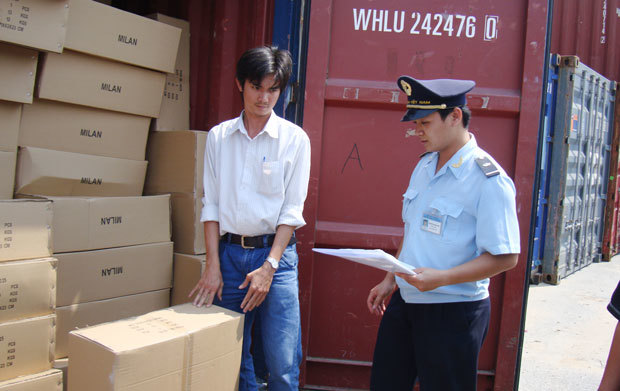
Specifically, Article 10a stipulates that during the implementation of inspection, supervision, and control measures for export and import goods related to intellectual property; through analysis of intellectual property databases; or based on information provided by customs operational units, if there is clear evidence to suspect that export or import goods are counterfeit trademark goods, counterfeit geographical indication goods, or pirated goods, the Head of the Customs Team at the place of declaration registration shall issue a Decision to suspend customs procedures.
Immediately after issuing the decision, customs must notify the intellectual property rights holder, copyright holder, related rights holder, or their legally authorized representative within 8 working hours from the issuance of the Decision to suspend customs procedures, while simultaneously conducting a physical inspection of the goods to determine the violation.
If the goods are determined to be counterfeit or infringe intellectual property rights, the customs authority will handle them according to regulations; if there are signs of criminal offense, they will be transferred to the competent authority for investigation.
Furthermore, Circular No. 06/2026/TT-BTC also introduces regulations on liability for compensation in Clause 5, Article 10a, applicable to the customs authority in cases of incorrect suspension of customs clearance.
The regulation clearly states that in cases of incorrect proactive suspension of customs procedures causing damage to the goods owner, the customs authority issuing the suspension decision must, within 10 working days, compensate the goods owner for damages and pay arising costs including storage, yard, handling, and preservation fees as prescribed.
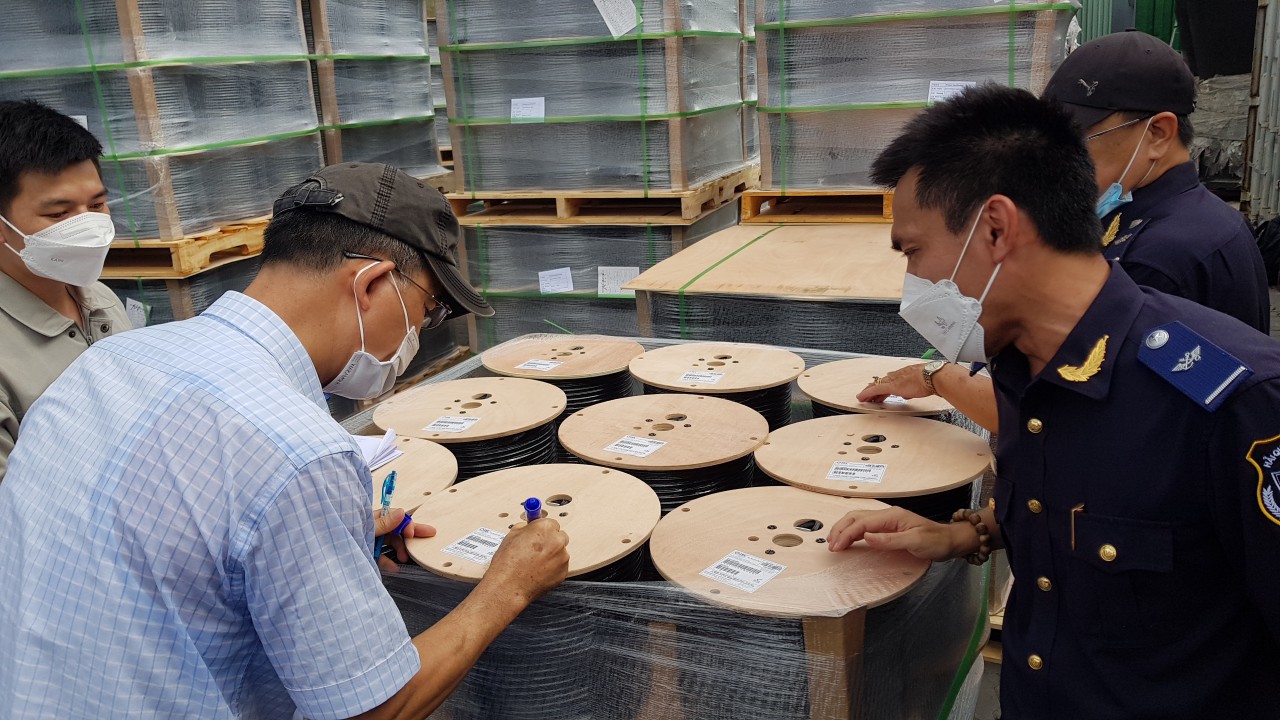
Transit goods, temporary import for re-export detained for inspection by Ho Chi Minh City Customs due to suspicion
The Circular also standardizes the process for receiving and handling dossiers requesting intellectual property rights protection, clearly stipulating a 20-working-day period for the Customs Department to consider, accept, or reject the dossier, while adding cases for refusal of acceptance to limit invalid dossiers.
Notably, dossiers requesting inspection and supervision are primarily processed through the Customs Electronic Data Processing System; paper dossiers are only accepted when the system encounters issues, aligning with the Law on Electronic Transactions and the orientation for digitalizing administrative procedures.
Another new point is the addition of regulations for inspecting and supervising goods related to intellectual property rights in e-commerce, applying risk management principles. For online transaction shipments showing signs of counterfeiting, customs will immediately apply the same suspension procedure as for traditional goods.
The Circular also comprehensively updates the system of terminology, authority, and organizational names according to the new model of the Customs sector, replacing "General Department of Customs" with "Customs Department", and "Provincial/City Customs Department" with "Regional Customs Sub-Department", ensuring uniformity in enforcement.
Circular No. 06/2026/TT-BTC adds Article 10a after Article 10 of Circular 13/2015/TT-BTC as follows:
1. During the implementation of inspection, supervision, and control measures for export and import goods related to intellectual property; through analysis of intellectual property databases; or based on information provided by customs operational units, if there is clear evidence to suspect that export or import goods are counterfeit trademark goods, counterfeit geographical indication goods, or pirated goods, the Head of the Customs Team at the place of declaration registration shall issue a Decision to suspend customs procedures according to Form No. 10, Appendix II issued together with this Circular.
2. The customs authority at the place of declaration registration shall notify the intellectual property rights holder, copyright holder, related rights holder, or their legally authorized representative within 08 working hours from the issuance of the Decision to suspend customs procedures, using the contact information in the accepted dossier, and notify relevant organizations and individuals via the Customs Electronic Data Processing System.
In case the Customs Electronic Data Processing System encounters issues or is unavailable, the customs authority at the place of declaration registration shall notify the relevant parties in writing.
3. The time limit for suspending customs procedures for counterfeit trademark goods and counterfeit geographical indication goods shall be implemented according to the provisions of Clause 3, Article 103 of Decree No. 65/2023/ND-CP dated March 28, 2023, and for pirated goods shall be implemented according to the provisions of Clause 3, Article 89 of Decree No. 17/2023/ND-CP dated April 24, 2023.
4. Immediately after issuing the Decision to suspend customs procedures, the customs authority at the place of declaration registration shall conduct a physical inspection of the goods to determine the violation and handle as follows: a) In case there is no violation, continue customs procedures according to the provisions of Article 11 of this Circular. b) In case the customs authority determines the suspended goods to be counterfeit trademark goods, counterfeit geographical indication goods, or pirated goods, handle them according to legal regulations. If the violation is determined to have signs of a criminal offense as stipulated in the Penal Code, the customs authority shall transfer the case to the competent authority for investigation and prosecution according to legal regulations.
c) In case there is insufficient basis to determine the violation, the customs authority at the place of declaration registration shall proceed with the following tasks:
c.1) Send complete images of the export/import goods to the intellectual property rights holder, copyright holder, related rights holder, or their legally authorized representative (if contact information is available);
c.2) Request the importer or exporter or the rights holder of the trademark or geographical indication; copyright holder, related rights holder, or their legally authorized representative (if contact information is available) to provide relevant documents related to the goods (catalog, appraisal conclusions, documents from abroad, results of handling similar cases...); c.3) Propose relevant organizations and individuals to take samples for appraisal according to Article 201 of the Intellectual Property Law No. 50/2005/QH11 as amended and supplemented by Clause 26, Article 1 of Law No. 36/2009/QH12 and Clause 78, Article 1 of Law No. 07/2022/QH15. Procedures for sampling, sampling techniques, sample storage location, and sample storage time shall follow the guidance of the Ministry of Finance (if necessary);
c.4) In cases requiring coordination and exchange with state management agencies on industrial property, copyright, and related rights when disputes or complaints arise regarding the rights holder; protectability; scope of protection for trademark or geographical indication rights or copyright, related rights; or authority to handle violations, base the handling on the written responses from the state management agencies according to regulations.d) In case the applicant initiates a civil lawsuit, the customs authority shall act according to the court's opinion;đ) Report to the directly responsible Regional Customs Sub-Department and the Customs Department for timely direction in handling cases beyond its authority.5. In case of incorrect proactive suspension of customs procedures causing damage to the goods owner, the customs authority issuing the suspension decision must, within 10 working days, compensate the goods owner for damages and pay arising costs including storage, yard, handling, and preservation fees as prescribed.6. Within 30 days from the date of issuing the decision to apply administrative measures for handling counterfeit trademark goods, geographical indication goods, and pirated goods according to Clause 1, Article 216 of the Intellectual Property Law No. 50/2005/QH11, the customs authority issuing the violation handling Decision shall have a written notice to the intellectual property rights holder or their legally authorized representative with the following information: name and address of the consignor; exporter, consignee or importer; description of the goods; quantity of goods; country of origin of the goods if known.”